
Jacksonville Climbs to 97th in Global Cities Index, Eyes Top-50 Ranking
An international economic report names Jacksonville a "City to Watch" and credits tech-sector growth for 26 percent of the city's GDP gains in 2025, fueling ambitions to crack the top 50 globally by 2032.
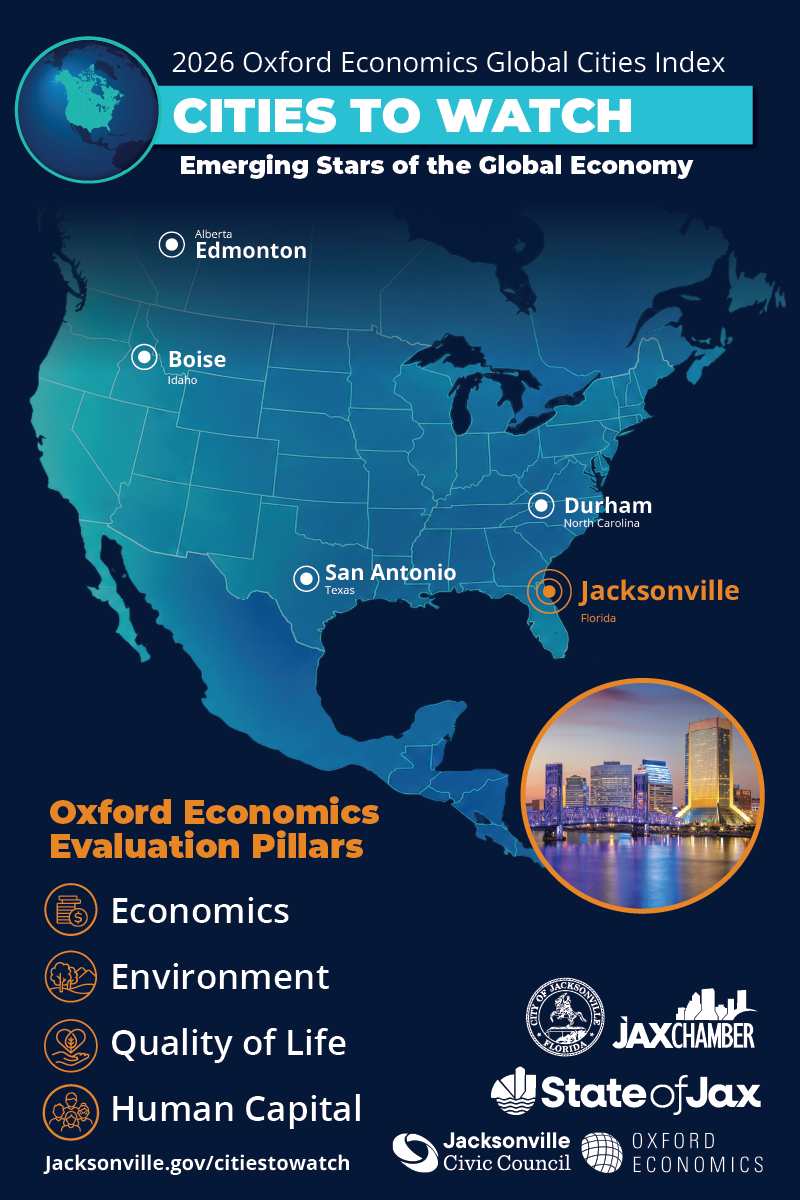
Jacksonville has climbed to 97th among the world's cities in the 2026 Oxford Economics Global Cities Index—up from 119th a year ago—and landed on the consultancy's curated "Cities to Watch" list, a recognition city leaders are using to anchor a public goal of cracking the global top 50 by 2032.
Oxford Economics, an international advisory firm, published the ranking on September 15, naming Jacksonville one of five North American metros to watch alongside Boise, Durham, San Antonio, and Edmonton. The firm selected the five cities not as a strict numerical ranking but as a curated list highlighting metros that have posted strong productivity gains and diverse employment growth despite recent global economic headwinds. Jacksonville is measured against cities with populations below 4 million.
What the index measures
The Oxford Global Cities Index evaluates 1,000 of the world's largest cities across five categories: Economics, Human Capital, Quality of Life, Environment, and Governance. The index draws on Oxford's proprietary economic forecasts and publicly available datasets to assess the broader conditions that shape a city's success and residents' lives, according to the report.
Jacksonville's rise was driven by what Oxford Economics described as a diversifying economy anchored by finance, technology, fintech, and professional business services. Technology alone contributed 26 percent of Jacksonville's total GDP growth in 2025, the report states. That sector growth helped push the city's GDP-per-job metric into the top 20 among U. S. metros, according to Oxford Economics.
The index forecasts above-average job growth for Jacksonville in the years ahead, including continued gains in technology and healthcare employment. Tech GDP and productivity growth are expected to outpace the national average, the report projects. Oxford Economics also forecast 1 percent population growth per year through 2030—nearly four times the U. S. average—and 2. 9 percent annual growth in income and consumer spending, above the national average.
The Civic Council, a nonprofit leadership group, identified the Oxford Economics Global Cities Index as a valuable series of metrics to help local institutions—government, businesses, philanthropy, and nonprofits—align around shared progress goals. City leaders set the goal of reaching the top 50 globally among cities with populations under 4 million sometime in the past year; the 2032 target date appears in graphics accompanying the announcement.
What it signals for investment and development
Recognition in a global economic index carries both symbolic and practical weight for a city's built environment. Rankings of this type are commonly cited by economic-development organizations when courting corporate relocations, expansions, and real-estate investment. A higher profile in international business research can influence site-selection consultants, who advise companies on where to locate offices, distribution centers, and manufacturing plants.
Jacksonville's metrics—particularly GDP-per-job and the outsized share of growth attributed to technology—paint a picture of an economy adding higher-productivity, higher-wage jobs rather than simply expanding headcount. That shift has direct implications for the types of real estate in demand. Technology, fintech, and professional-services employers typically seek modern office space with amenities, walkable urban settings, and access to talent pipelines, rather than suburban office parks or industrial flex space.
The forecast of nearly 1 percent annual population growth through 2030—four times the national average—translates to sustained pressure on housing supply, infrastructure, and services. At that rate, the Jacksonville metro would be expected to add tens of thousands of residents over the next several years, each requiring a place to live, roads to drive on, schools for children, and utility capacity. How the region accommodates that growth—through infill development downtown and in established neighborhoods, greenfield subdivisions on the urban fringe, or some combination—will determine the character of Jacksonville's expansion and the fiscal burden on taxpayers.
The report's citation of recent investment activity, along with Jacksonville's beaches, wildlife preserves, and water sports, underscores that quality-of-life assets are being factored into the city's competitive position. Developers and employers increasingly weigh livability when choosing locations, and the presence of natural amenities can justify premium residential pricing and attract out-of-state buyers. The interplay between environmental assets and development pressure is a recurring tension in Northeast Florida, where wetlands, river corridors, and coastal zones are both economic attractions and regulatory constraints.
How tech-sector growth reshapes real estate demand
When technology accounts for more than a quarter of a city's GDP growth, the real-estate footprint of that sector expands proportionally. Tech companies and their employees drive demand across multiple property types: creative office space, co-working facilities, workforce housing near job centers, and retail and hospitality in walkable districts.
Jacksonville's technology employers range from financial-technology firms—leveraging the city's finance legacy—to software developers, IT services, and digital-health startups. These businesses tend to cluster in areas with fiber connectivity, proximity to universities and talent, and urban amenities. Downtown Jacksonville, the Southbank, and corridors such as San Marco and Riverside have seen office conversions, adaptive reuse, and new mixed-use projects in recent years, a pattern consistent with tech-sector growth.
Higher-wage jobs also influence residential real estate. Workers in technology and professional services typically have purchasing power that supports new apartments, townhomes, and single-family housing at higher price points. This dynamic can accelerate gentrification in transitional neighborhoods and widen affordability gaps for lower-income residents, a tradeoff that has become a central urban-policy question in cities experiencing rapid job growth.
The forecast productivity and GDP-per-job gains suggest Jacksonville is adding value, not just volume, to its economy. For commercial landlords and developers, that can mean rising lease rates and falling vacancy in Class A office space, but also heightened competition for sites near downtown, the urban core, and transit connections. For industrial and logistics real estate—traditionally a mainstay of Jacksonville's economy—the question will be whether that sector continues to grow in absolute terms even as its share of GDP declines relative to higher-productivity industries.
What a top-50 ranking would require
Climbing from 97th to the top 50 globally by 2032 implies sustained improvement across the five index pillars: Economics, Human Capital, Quality of Life, Environment, and Governance. Each pillar encompasses multiple data points, from educational attainment and air quality to patent filings and public safety.
Human Capital—workforce education, skills, and talent pipelines—is a common constraint for fast-growing metros. Jacksonville's recent opening of a University of Florida campus, mentioned in the announcement, is one mechanism for expanding degree production locally and retaining graduates. Continued gains in this category would likely require further investment in K-12 outcomes, post-secondary enrollment, and workforce-training programs aligned with employer needs.
Quality of Life and Environment are areas where Northeast Florida has structural advantages—beaches, the St. Johns River, preserves—but also faces challenges tied to growth. Traffic congestion on I-95, I-295, and Butler Boulevard is a daily reality for commuters. Flood risk, stormwater management, and water quality in the river and tributaries are environmental metrics that factor into livability indexes. How the city and region manage infrastructure expansion, tree canopy, green space, and resilience to sea-level rise and storm surge will influence those scores.
Governance measures often include metrics such as fiscal health, transparency, service delivery, and ease of doing business. Permitting timelines, development-review processes, and coordination among city, county, and regional agencies all fall under this heading. For developers and businesses, predictable and efficient government processes reduce risk and cost, making a city more competitive.
The index does not publish granular breakdowns of each city's scores, so it is difficult to pinpoint precisely where Jacksonville would need to improve most. What is clear is that a rise of nearly 50 places in six years would require sustained, measurable progress on multiple fronts—progress that touches schools, roads, housing, environment, and institutions across the seven-county region.
What happens next
The Jacksonville Civic Council, JAX Chamber, and city government have adopted the Oxford Economics index as a shared scorecard. A website, Jacksonville. gov/citiestowatch, has been set up to track progress. The next index update from Oxford Economics would typically be published in 2027, providing an annual checkpoint on whether Jacksonville continues to climb or stalls.
Public and private stakeholders can be expected to reference the ranking in upcoming policy debates: capital-improvement budgets, incentive packages for employers, zoning and land-use decisions, and infrastructure priorities. Economic-development marketing materials will feature the "City to Watch" designation and the trajectory from 119th to 97th.
For residents, the practical question is whether the investment, job growth, and recognition translate into visible improvements—better roads, more parks, stronger schools, safer neighborhoods—or whether growth outpaces the infrastructure and services needed to support it. The index offers a global benchmark, but the lived experience of a city's trajectory is measured block by block, in commute times, housing costs, school capacity, and neighborhood change.
The ambition to reach the global top 50 by 2032 ties Jacksonville's development story to an international yardstick, raising both expectations and accountability. Whether that goal is met will depend on decisions made in the coming years by elected officials, developers, employers, and institutions—decisions that will reshape the region's built environment and economy for decades to come.
Sources
- City of Jacksonville: Jacksonville Named One of North America’s Top Five Cities to Watch by Oxford Economics