Jacksonville earns LEED Platinum, joining elite group of 10 cities worldwide
The certification measures citywide performance in energy, water, transportation, and quality of life—and city leaders say it will help attract business investment to Northeast Florida.
Jacksonville has achieved LEED for Cities Platinum certification, placing the city among only 10 in the world to hold the highest level of environmental and sustainability recognition available through the internationally recognized rating system managed by the U. S. Green Building Council.
Mayor Donna Deegan announced the achievement September 3, describing it as an extraordinary accomplishment that reflects how city departments serve the community daily—from fire rescue and critical infrastructure to solid waste, water testing, health initiatives, resilience planning, and environmental stewardship programs.
What the certification measures
LEED for Cities goes beyond the traditional LEED green building rating system used for individual structures. Instead, it measures performance and strategy across an entire municipal jurisdiction, helping local governments benchmark progress, set priorities, and make data-driven decisions.
The certification evaluates city performance across eight categories: natural systems and ecology, transportation and land use, energy, water, materials and resources, quality of life, innovation, and regional priorities. Jacksonville earned the Platinum designation—the highest of four tiers—by demonstrating measurable strategies and outcomes in each area.
The achievement represents nearly two years of cross-departmental work, funded by a Bank of America grant and coordinated by the City's Office of Sustainability. Employees across City government, agencies, and community organizations contributed data, documented programs and policies, and benchmarked Jacksonville's performance against other cities through the LEED framework.
The certification specifically highlights the city's commitment to reducing resource consumption, advancing environmental and public health, supporting housing stability, and investing in key programs including the Elderly Food Insecurity Initiative, Keep Jacksonville Beautiful, the Art in Public Places Program, Emerald Trail development, and the Lights Out Northeast Florida partnership.
What it means for business investment and economic development
City leaders framed the certification as more than an environmental award, emphasizing its potential to influence business location and investment decisions. Mayor Deegan said the Platinum designation "will lead to more business investment in our community. "
The certification provides credible, third-party performance data that is increasingly valued by businesses, investors, and capital markets when evaluating where to locate operations or deploy capital. Companies making site-selection decisions—particularly those with their own sustainability commitments or Environmental, Social, and Governance (ESG) reporting requirements—often factor municipal environmental performance into their analyses.
"LEED Platinum gives us more than recognition. It gives us a comprehensive picture of where Jacksonville is today and a framework for where we can go next," said Ashantae Green, Sustainability Manager for the City of Jacksonville. "It is also a competitive advantage, providing measurable data to identify efficiencies, strengthen funding opportunities and demonstrate to businesses and residents that Jacksonville is planning for long-term growth and resilience. "
The certification supports many of the same priorities that investors, rating agencies, and resilience programs look for when evaluating municipalities, including long-term planning, risk reduction, climate preparedness, infrastructure management, and effective governance. These factors can influence municipal bond ratings, federal and state grant competitiveness, and private-sector partnership opportunities.
For Jacksonville, which has pursued major corporate expansions and data-center projects in recent years as part of a broader economic-development push, the certification offers a standardized way to communicate the city's planning capacity and long-term infrastructure stability to prospects.
How the certification affects residents and quality of life
From the public's perspective, LEED for Cities demonstrates accountability and transparency by producing measurable outcomes rather than aspirational goals. The framework requires cities to track and report performance metrics that affect daily life—air and water quality, transportation access, energy efficiency, and public health initiatives.
The programs and partnerships highlighted in Jacksonville's application have direct touchpoints with residents. The Elderly Food Insecurity Initiative addresses hunger among vulnerable older adults. Keep Jacksonville Beautiful coordinates litter cleanup and beautification efforts citywide. The Emerald Trail, a planned 30-mile network of trails and parks connecting urban neighborhoods, represents a major infrastructure investment in walkability and green space.
The Lights Out Northeast Florida partnership addresses light pollution and bird strike hazards during migration season, when artificial lighting can disorient and kill birds traveling along the Atlantic Flyway. These programs reflect the kind of cross-sector collaboration—public agencies, nonprofits, and community organizations—that the LEED framework is designed to encourage.
The certification also measures how the city manages basic services that residents interact with regularly: solid waste collection and diversion, water quality testing and treatment, fire rescue response, and infrastructure maintenance. By benchmarking these functions against other cities, Jacksonville can identify performance gaps and efficiencies.
Peter Templeton, President and CEO of the U. S. Green Building Council, said in a statement that "a sustainable city balances social, economic and environmental concerns in its decision making and planning. A LEED city takes those plans forward as solutions that improve the overall quality of life for its residents. "
What happens next
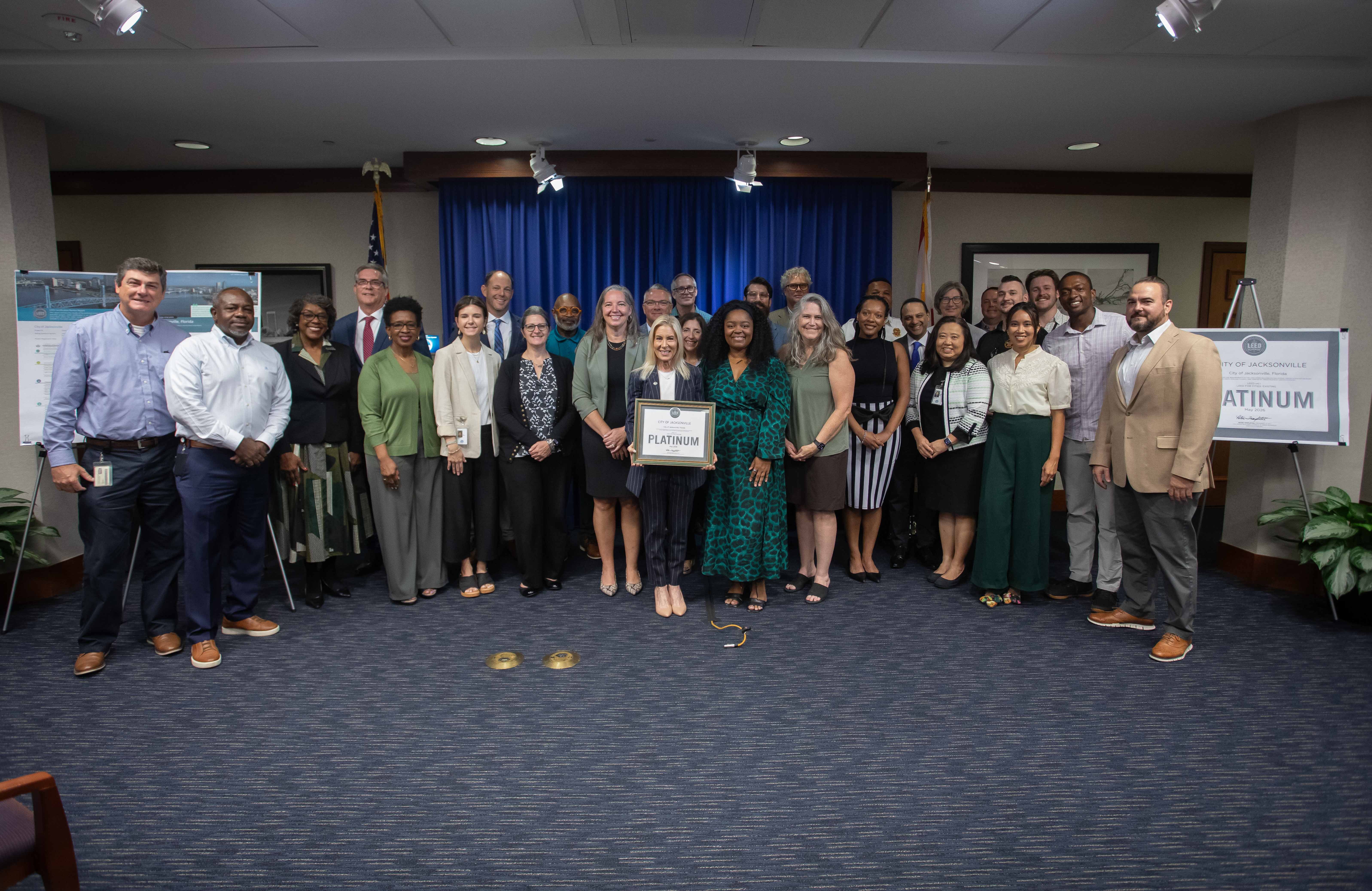
The City celebrated the achievement at a recognition ceremony at City Hall with the Mayor, Hilari Varnadore, Vice President of State and Local Government for the U. S. Green Building Council, city leadership, and employees representing the departments that contributed to the certification.
A LEED for Cities Platinum plaque is now permanently displayed in Jacksonville City Hall. A sign at Riverfront Plaza also commemorates the city's place among the select group of communities worldwide to achieve the highest level of certification.
LEED for Cities certification is not a one-time designation. Maintaining the certification requires ongoing data collection, performance monitoring, and periodic recertification, typically every three years. Cities must demonstrate continued progress and performance to retain their status, creating an accountability loop that ties municipal operations to measurable environmental and quality-of-life outcomes.
The framework Green described—using the certification as a baseline to identify where Jacksonville can improve next—suggests the city will continue using the LEED metrics to guide decisions on infrastructure investment, policy development, and resource allocation in the years ahead.
Growth, resilience, and Northeast Florida's future
Jacksonville's Platinum certification arrives as the broader Northeast Florida region experiences rapid population growth and development pressure. St. Johns County remains one of Florida's fastest-growing counties, Clay County is adding subdivisions along the First Coast Expressway corridor, and Nassau County is absorbing growth around the Wildlight master-planned community near Yulee.
That growth brings infrastructure demands—water, sewer, roads, schools—that test local governments' capacity to plan, finance, and deliver services. The LEED for Cities framework gives Jacksonville a structured process to manage those pressures while balancing environmental stewardship, fiscal responsibility, and economic competitiveness.
As consolidation city-county government for most of Duval County, Jacksonville's planning and infrastructure decisions shape the region's development patterns. The certification signals that the city is integrating long-term resilience planning—flood risk, climate preparedness, resource management—into the foundation of how it operates, a posture that will become more material as the region continues to grow and face the environmental realities of coastal Florida.
Sources
- City of Jacksonville: JACKSONVILLE ACHIEVES LEED FOR CITIES PLATINUM CERTIFICATION