
JAXPORT names new Blount Island roadway for late operations chief
The port authority approved construction of a western entrance and security plaza at Blount Island Marine Terminal, naming the route James Bennett Way after the COO who oversaw the project before his death in 2025.
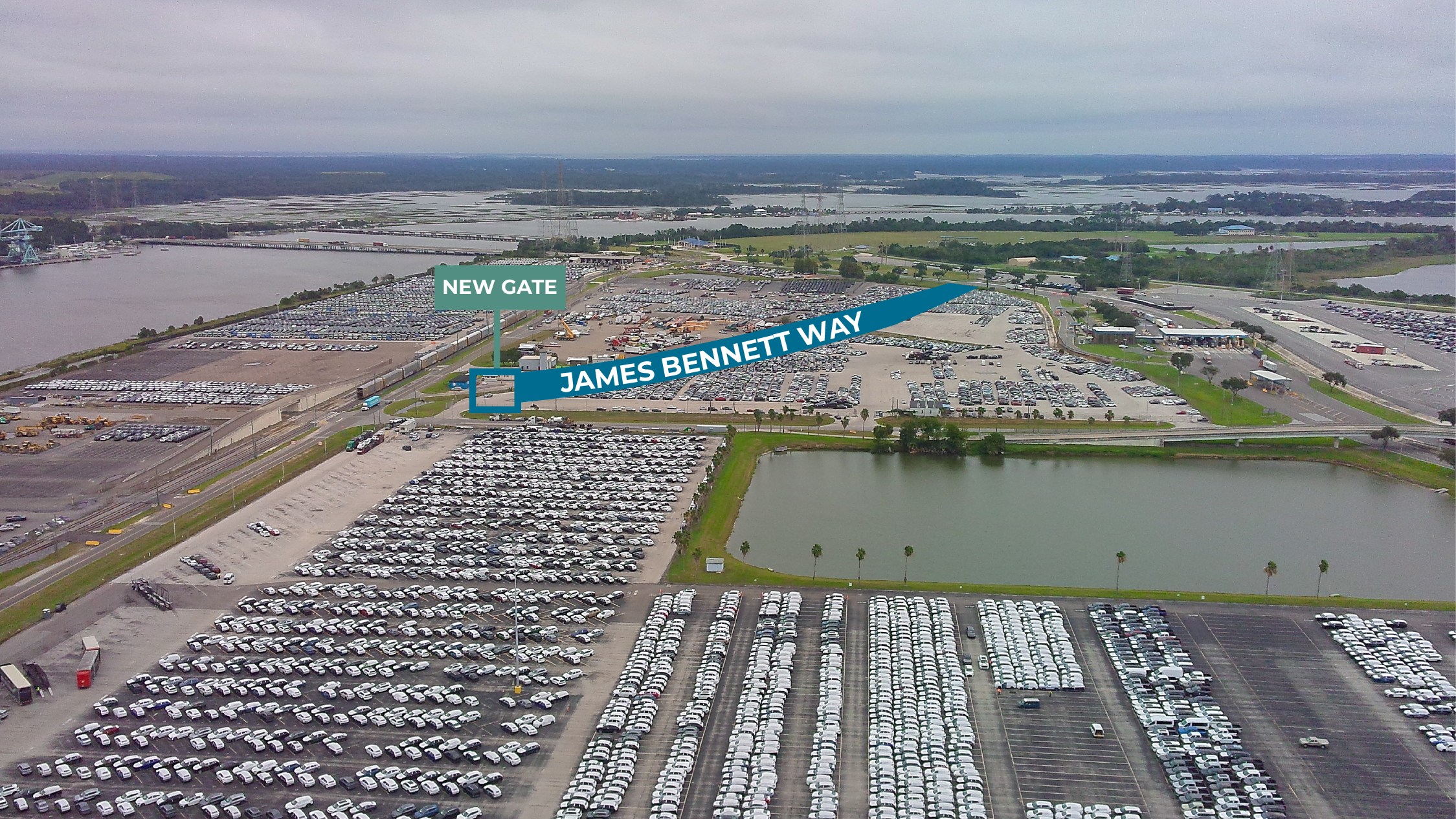
The JAXPORT Board of Directors has approved construction of a new western entrance to Blount Island Marine Terminal, naming the roadway after James Bennett, the port's late chief operating officer who helped develop the project before his death in December 2025.
The board voted to designate the new route James Bennett Way during its September 28 meeting, which also featured a series of tributes to Bennett, including a Jacksonville City Council resolution and the formal dedication of a scholarship endowment in his name that has raised more than $181,000.
What's happening
The new entrance project includes a 2,073-linear-foot road connecting Dave Rawls Boulevard to Blount Island Boulevard, a new security plaza and canopy, and a 1,318-square-foot security building. The route is designed to reduce traffic volume at the terminal's main gate by providing an additional access point to the facility.
Upon completion, the security plaza will display a plaque recognizing Bennett's contributions to JAXPORT. Bennett served the port authority for eight years, first as senior director of engineering and construction and then, beginning in 2022, as chief operating officer. He died December 8, 2025, following an automobile accident.
During his tenure, Bennett oversaw JAXPORT's annual capital program of more than $250 million and helped lead major improvements to the port's marine and landside infrastructure, including the deepening of the Jacksonville shipping channel to 47 feet and the expansion of Blount Island's container and vehicle-handling capabilities.
"James understood that infrastructure is about more than concrete and pavement. It is about connecting people, improving safety and preparing our port for the future," said JAXPORT CEO Eric Green. "This new entrance reflects that vision. It will provide another access point to one of our busiest terminals while honoring the person who helped bring it to life. "
Why traffic flow matters at Blount Island
Blount Island Marine Terminal is one of JAXPORT's primary cargo-handling facilities and serves as a major container and vehicle-processing hub for Northeast Florida. The terminal sits on the St. Johns River's north side, accessible from the Northside via Heckscher Drive and Blount Island Boulevard.
Traffic congestion at marine terminal gates is a common bottleneck in port operations. A single point of entry means all trucks, workers, and service vehicles funnel through one security checkpoint. During shift changes, peak cargo-handling hours, or when large vessels are being loaded or unloaded, gate queues can slow truck turnaround times and create backups onto nearby roads.
By adding a western entrance along Dave Rawls Boulevard—which serves the broader Blount Island industrial area—the project aims to distribute vehicle flow across two gates rather than one. For trucking companies and logistics operators using the terminal, reduced wait times translate to more loads per day and lower operating costs. For port tenants and workers, a second gate offers redundancy if the main entrance experiences delays or must be temporarily closed.
The security plaza and dedicated building indicate that the new entrance will be a fully staffed, permanent access point, not a supplementary or emergency gate. JAXPORT, like all U. S. seaports, operates under federal Transportation Worker Identification Credential (TWIC) and Maritime Transportation Security Act requirements, meaning all terminal access points require controlled entry and screening infrastructure.
How the project fits JAXPORT's broader expansion
The western entrance is one piece of ongoing infrastructure investment at Blount Island, which has seen significant upgrades in recent years as JAXPORT positions itself to handle larger vessels and higher cargo volumes following the completion of the Jacksonville Harbor Deepening Project.
That deepening effort—which brought the shipping channel to 47 feet, one of the achievements Bennett oversaw—allows the port to accommodate Post-Panamax container ships that previously could only call at Jacksonville partially loaded or at high tide. Deeper water drives demand for expanded terminal capacity, both in acres of container-stacking yard and in gates that can efficiently move cargo in and out.
JAXPORT's capital program, which Bennett managed, has consistently exceeded $250 million annually in recent years. That spending includes wharf strengthening, crane acquisitions, container-yard paving, rail connections, and now roadway and gate infrastructure. Each element is part of a system: deeper channels and bigger cranes are of limited value if trucks cannot move cargo off the terminal quickly.
For the Northside industrial corridor, the roadway investment signals continued growth at Blount Island. The terminal and adjacent industrial areas are among Duval County's largest concentrations of logistics and manufacturing jobs. Improved port infrastructure typically supports tenant expansions and can make the site more attractive to new shipping lines or cargo owners evaluating where to route goods.
Memorial endowment and workforce development
The September 28 board meeting also formalized the James Bennett Memorial Endowed Scholarship at the University of North Florida. The fund has raised $181,250 from nearly 80 donors and will support two UNF students annually—one studying transportation and logistics in the Coggin College of Business and one studying engineering in the College of Computing, Engineering and Construction.
The first scholarship awards are planned for 2027. The Florida Department of Transportation has committed to offering each scholarship recipient a paid internship, creating a direct pipeline from academic study to hands-on experience in the state's infrastructure and logistics sector.
Workforce development is a persistent challenge in both port operations and civil engineering. As JAXPORT and other regional infrastructure agencies manage large capital programs, the availability of trained engineers, project managers, and logistics professionals directly affects project timelines and costs. Endowed scholarships create a recurring funding source that can support students over many years without requiring annual fundraising.
"James devoted his career to building a stronger future for JAXPORT," said JAXPORT Board Chair Palmer Clarkson. "It is fitting that this road—one he envisioned and helped bring to life—will carry his name and his legacy forward. "
What happens next
The JAXPORT board's approval clears the way for construction of the new entrance to begin, though the port authority did not announce a construction timeline or completion date in its announcement. Infrastructure projects of this type typically require final design, permitting, contractor procurement, and coordination with terminal operations to minimize disruption during construction.
Once complete, the security plaza will display a permanent plaque recognizing Bennett's role in the project. The U. S. Army Corps of Engineers also presented a survey marker honoring Bennett that will be installed at JAXPORT as a permanent reference point supporting navigation. Bennett worked closely with the Corps throughout the Jacksonville Harbor Deepening Project.
Jacksonville City Council President Nick Howland presented a City Council resolution during the meeting honoring Bennett's life and contributions to the community, reflecting the regional significance of the port's infrastructure program and the role Bennett played in managing it.
A legacy in concrete and capacity
James Bennett Way will join a small number of roadways and facilities at JAXPORT named for individuals who shaped the port's growth. As Northeast Florida's cargo volumes rise and the region's logistics footprint expands from JAXPORT through the I-95 and I-295 corridors to inland distribution centers, the infrastructure Bennett helped plan will continue to influence how goods move and how many jobs the port supports.
The new entrance is a tangible piece of that system—a route that will be driven thousands of times each week by workers and truckers, most of whom may never know the name on the sign. But for the engineers, planners, and port operators who understand the complexity of moving millions of tons of cargo efficiently and safely, the roadway stands as a reminder that infrastructure is built by people, and that the decisions made today shape the region's capacity for decades to come.