
JAXPORT ramps up heavy-lift infrastructure as data centers strain U. S. power grid
Demand for imported transformers and generators has spiked 274% since 2019, and Jacksonville's seaport is positioning itself as a critical gateway for oversized electrical equipment bound for the Southeast's booming industrial corridor.
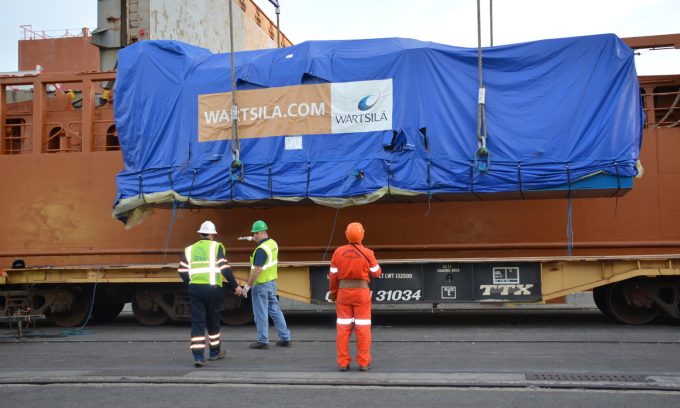
Jacksonville's seaport is positioning itself at the center of a national infrastructure squeeze, as surging demand for data centers and industrial facilities drives a scramble for the massive electrical equipment needed to power them. U. S. demand for the largest power transformers has climbed 274% in just six years, and with domestic supply unable to keep pace, imported equipment flowing through ports like JAXPORT has become critical to keeping the lights on.
In a detailed planning guide published this week, JAXPORT outlined its capabilities for handling oversized electrical cargo — transformers, generators, and other grid components that can weigh hundreds of thousands of pounds and require years of advance planning to move. The port has already demonstrated its capacity, moving a 331,000-pound generator through its Blount Island heavy-lift terminal, which offers load capacity of up to 2,000 pounds per square foot, on-dock rail connections, and high-and-wide rail clearances designed for exactly this type of cargo.
What's happening
According to the September 15 update from JAXPORT Marketing Director Jeff Price, demand for generator step-up transformers — which convert generator output to transmission voltage — increased 274% between 2019 and 2025, based on research from Wood Mackenzie. Demand for substation power transformers rose 116% over the same period.
The U. S. Department of Energy estimates that imports now supply approximately 82% of large power transformers used in the United States. Lead times for these components have stretched dramatically: industry estimates put average delivery at roughly 128 weeks for power transformers and 144 weeks for generator step-up units, with some large custom units quoted at up to four years from order to delivery.
Data-center construction is a major driver. ConstructConnect valued U. S. data-center construction starts through June 2026 at $81. 5 billion — already surpassing the $72. 5 billion recorded during all of 2025. The Department of Energy has identified data centers and domestic manufacturing among the primary forces increasing electricity demand and straining grid-component supply chains.
JAXPORT's Blount Island terminal serves as the port's heavy-lift hub. The facility's berth can handle cargo weighing up to 2,000 pounds per square foot and offers direct rail access with clearances for oversized loads. The port currently hosts a mix of breakbulk and multipurpose carriers, including G2 Ocean, Saga Welco, Spliethoff, Wagenborg, and Schuyler Line Navigation, with additional capacity available through charter calls.
The planning guide emphasizes that moving this equipment requires coordination months in advance. Shippers must provide verified weight, dimensions, center of gravity, lifting points, and detailed drawings at the booking stage. High-value or complex shipments may require approval from an independent marine warranty surveyor as a condition of insurance coverage. Wood packaging materials must comply with international ISPM 15 phytosanitary standards, and cargo leaving the terminal by heavy-haul truck requires Florida oversize or overweight permits, route surveys, and escort coordination.
Why Northeast Florida is in the supply chain
Jacksonville sits at the intersection of several forces reshaping the region's industrial landscape. The port's geographic position on the East Coast, combined with its inland river access and direct interstate connections, makes it a natural gateway for equipment destined for the Southeast's rapidly expanding data-center and manufacturing belt.
Northeast Florida itself is part of that buildout. Large-scale industrial projects are proliferating across the region — from Cecil Commerce Center on Jacksonville's Westside, the largest industrial land bank in the area and a former naval air station now devoted to logistics and advanced manufacturing, to greenfield sites in Clay and Nassau counties where the First Coast Expressway and other new road infrastructure have opened rural land to development.
Data centers in particular place extraordinary demands on electrical infrastructure. A single large facility can require tens to hundreds of megawatts of power — utility-scale loads that necessitate dedicated substations, new transmission lines, and the exact type of heavy transformers JAXPORT is now moving. Each of those transformers must arrive by sea, clear customs, and travel overland to its final destination, often on routes that require engineering surveys to confirm bridge clearances and pavement strength.
JEA, Jacksonville's city-owned utility and one of the largest municipal electric and water providers in the United States, has publicly discussed grid investments to support industrial growth. Any major power customer — whether a data center, a manufacturing plant, or a distribution hub — requires not only generation capacity but also the step-down transformers and switchgear to deliver that power reliably. These components are the physical bottleneck in the system, and they flow through ports.
The port's emphasis on early planning reflects a broader reality: the timeline for large electrical equipment now stretches three to four years from order to energization. For a developer breaking ground on a facility in 2027, the transformer may need to be ordered in 2024 or earlier. That equipment will spend weeks at sea, days or weeks at the port, and additional time in transit to the project site. Any delay in permitting, lifting, or inland transport can push back a facility's in-service date and cost millions in lost revenue or contract penalties.
What this means for the regional economy
JAXPORT's focus on heavy-lift cargo positions Duval County as a logistics hub for one of the fastest-growing segments of industrial infrastructure. The immediate economic impact is measurable in port throughput, stevedoring jobs, and related services — crane operators, rigging specialists, heavy-haul trucking firms, and the marine surveyors and customs brokers who facilitate each move.
But the second-order effects may be larger. Ports that can reliably handle oversized, time-sensitive cargo attract the freight forwarders and project-logistics companies that plan these moves. Those firms bring expertise, relationships, and repeat business. Over time, that expertise clusters: warehousing and transloading facilities locate nearby, trucking companies invest in the specialized trailers required for 300,000-pound loads, and rail operators develop the operational knowledge to move high-and-wide cargo without incident.
For existing industrial employers and prospective site selectors, port capability is a key input. A manufacturer evaluating a Northeast Florida site will want to know whether it can import heavy machinery without chartering a vessel to a distant port and trucking it hundreds of miles overland. A data-center developer will want confidence that transformers ordered from Europe or Asia can arrive on schedule. JAXPORT's ability to answer "yes" makes the region more competitive.
The guide's detailed checklist — covering everything from lashing engineering to ISPM 15 wood-packaging compliance — signals that the port is not simply offering a berth but a coordinated service. That distinction matters in a market where delays are costly and equipment is irreplaceable on short notice. The UK P&I Club and DNV standards cited in the guide are industry benchmarks; invoking them demonstrates that JAXPORT and its terminal operators are working to those standards.
There is also a competitive dimension. Other Southeast ports — Savannah, Charleston, and the deepwater terminals at Port Everglades and Miami — are vying for the same cargo. JAXPORT's advantages include its inland river access, which can reduce drayage costs for cargo moving to interior destinations, and its comparatively uncongested terminals, a selling point during the supply-chain snarls of recent years. The port's on-dock rail at Blount Island is particularly valuable for cargo that exceeds highway weight limits or requires permits that make trucking impractical.
How the supply chain actually works
The complexity of moving a single transformer illustrates why early coordination matters. A European manufacturer completes a unit weighing 300,000 pounds and measuring 25 feet long, 12 feet wide, and 15 feet tall. It is loaded onto a wooden skid and crated for ocean transport. That crate must be lifted by a gantry crane or ship's gear onto a multipurpose vessel, secured with welded grillage and lashings engineered to withstand North Atlantic sea states, and stowed in a way that satisfies the vessel's stability and structural limits.
Before the vessel sails, the shipper must provide U. S. Customs with a commercial invoice, packing list, and bill of lading that agree in every detail. The tariff classification under the Harmonized Tariff Schedule determines duties and whether any trade remedies apply. If the cargo's value or technical complexity triggers an insurance requirement for a marine warranty surveyor, that surveyor must review the lift plan, approve the seafastening design, and potentially witness the load-out — each of which adds days to the schedule.
Upon arrival at JAXPORT, the cargo is discharged using the terminal's heavy-lift cranes, a process that requires precise rigging to avoid shifting the load or overstressing lifting points. The cargo is then placed onto a heavy-haul trailer. Florida's Department of Transportation must issue an oversize/overweight permit specifying the route, travel times (often restricted to overnight or weekends to minimize traffic disruption), and escort requirements. County or municipal road departments may need to grant additional approvals if the route crosses locally maintained infrastructure.
The truck driver must verify clearance at every overhead structure — power lines, traffic signals, bridge underpasses — and may need to coordinate with utilities to temporarily raise or de-energize lines. At the destination substation, another crane offloads the transformer onto its foundation, where it will be connected, tested, and eventually energized. Each hand-off involves contracts, insurance, liability, and tight scheduling. A missing document, an incorrect center-of-gravity figure, or a delayed permit can cascade into weeks of delay.
JAXPORT's guide is explicit about these risks. It notes that cargo data and lift plans should be treated as "booking-stage deliverables," not afterthoughts. It warns that "providing this information only shortly before arrival can delay engineering approval, equipment selection or labor scheduling. " For supply-chain managers accustomed to containerized freight, where a box is a box, project cargo requires a different discipline.
What happens next
JAXPORT has not announced new terminal expansions or crane acquisitions in connection with the heavy-lift push, but the planning guide itself functions as a market signal: the port is open for this business and has the infrastructure and expertise in place. Inquiries from shippers and freight forwarders would typically flow to the port's business-development team and to the terminal operators and stevedores that handle breakbulk and project cargo at Blount Island.
The port's breakbulk service roster lists the carriers currently calling Jacksonville. Some operate on fixed schedules; others offer flexible or inducement calls depending on cargo volume. Charter capacity is also available for shipments that do not fit a liner schedule. Shippers planning moves in 2027 and beyond would need to confirm vessel availability, port-call timing, and terminal capabilities for each specific shipment, as the published schedule is described as a starting point rather than a comprehensive timetable.
For the broader industrial sector, the question is whether transformer and generator supply will catch up to demand. The 274% increase in demand since 2019 reflects a structural shift — not a temporary spike — driven by data centers, electrification, and the retirement of aging grid equipment. Domestic manufacturing capacity is growing but remains limited; the DOE has launched initiatives to reshore transformer production, but new factories take years to permit, build, and ramp up. In the meantime, imports will remain the primary source, and ports the chokepoint.
The Florida Department of Transportation's oversize/overweight permit office will continue to process applications for heavy haul, and any sustained increase in large-transformer imports will test the agency's ability to turn around permits quickly and to maintain roads and bridges capable of handling these loads. Local governments along major haul routes — particularly counties in Northeast Florida that have seen rapid residential growth but may not have industrial-strength road infrastructure — will face decisions about pavement upgrades, bridge reinforcements, and traffic management.
The bigger picture
JAXPORT's heavy-lift initiative is one piece of a much larger infrastructure story unfolding across Northeast Florida. The region's population and economy are growing faster than much of the state, driven by migration from higher-cost metros, military anchors at NAS Jacksonville and Naval Station Mayport, and an increasingly diversified economic base that includes logistics, advanced manufacturing, financial services, and technology.
That growth requires power — lots of it. Every new subdivision, every warehouse, every data center, every industrial plant adds load to the grid. JEA and the regional investor-owned utilities must build or upgrade substations, extend transmission lines, and procure the equipment to make it all work. Much of that equipment will arrive as breakbulk cargo through JAXPORT, travel the region's highways under permit, and ultimately be installed in substations that most residents will never notice but that underpin everything else.
The port's role in that system is often invisible to the public but essential to developers, utilities, and the industries that depend on reliable power. By publishing a detailed guide to the logistics, permitting, and engineering requirements of heavy electrical cargo, JAXPORT is making that role explicit — and positioning Northeast Florida as a region that understands the infrastructure demands of the 21st-century economy and is building the capacity to meet them.