
New Traffic Signal Opens at Nocatee Intersection in St. Johns County
St. Johns County completed a seven-month project at Colonnade Drive and Preservation Trail, adding a traffic signal and protected crossings for golf carts and pedestrians.
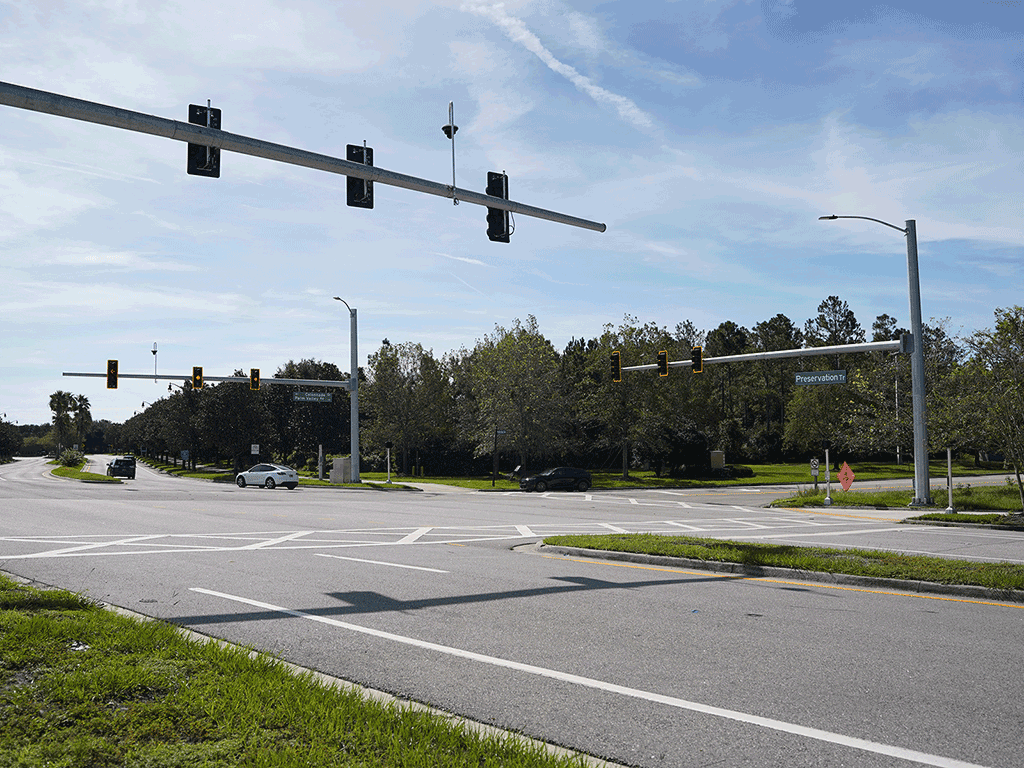
A new traffic signal is now fully operational at one of Nocatee's key internal intersections, the product of a seven-month St. Johns County project that aimed to smooth vehicle traffic and add protected crossings for the community's heavy golf cart use.
St. Johns County completed the intersection improvements at Preservation Trail, Colonnade Boulevard and Palm Valley Road in August 2026, following construction that began in February. The project installed a new traffic signal with designated phases for vehicles and a protected crossing phase for pedestrians and golf carts.
What's happening
The completed project includes a fully operational traffic signal at the intersection of Preservation Trail, Colonnade Boulevard and Palm Valley Road in Nocatee. According to the St. Johns County Public Works Traffic and Transportation Department, the signal provides designated phases for vehicles traveling through the intersection, creating more predictable traffic movements.
Construction ran from February 2026 through August 2026. The county conducted a traffic signal warrant analysis based on federal guidelines established in the Manual on Uniform Traffic Control Devices (MUTCD) before approving the project. The intersection met signal warrants based on traffic volumes, the county said.
Colonnade Drive and Preservation Trail serve as primary neighborhood connectors within Nocatee, carrying consistent daily residential traffic with increased volumes during school and commuter hours, according to the county announcement.
The project also installed dedicated pedestrian and golf cart crossings with a protected crossing phase. Michael Likley, project manager for the St. Johns County Public Works Traffic and Transportation Department, said the signalization provides clearly defined movements for drivers, pedestrians and golf cart users.
Golf cart infrastructure reflects Nocatee's design
The dedicated golf cart crossing highlights a defining feature of Nocatee's master-planned community design. Golf carts are a primary mode of short-distance transportation in the development, which spans more than 14,000 acres in eastern St. Johns County along the Intracoastal Waterway.
Nocatee is consistently ranked among the top-selling master-planned communities in the United States, with thousands of homes built across multiple villages. The community's network of trails, parks and amenities was designed to be accessible by golf cart, and residents routinely use the vehicles for trips to schools, shopping, restaurants and recreational facilities.
The protected crossing phase at Colonnade and Preservation Trail was incorporated specifically to accommodate the golf cart traffic within the community, the county said. The crossing connects neighborhoods throughout Nocatee and provides residents with improved access to nearby parks, recreational facilities, shopping and restaurants.
In master-planned communities like Nocatee, golf cart infrastructure is typically considered alongside traditional pedestrian and vehicle facilities during the planning and approval process. The crossing infrastructure at this intersection reflects that multi-modal approach, treating golf carts as a legitimate transportation mode alongside cars and foot traffic.
Traffic flow and commuter patterns
The traffic signal addresses a practical problem for Nocatee residents navigating the community's internal street network during peak hours. Likley, the county project manager, said the signal provides each movement with its own designated phase, which keeps traffic moving and gives motorists a clear understanding of when it's their turn to proceed.
Before the signal was installed, the intersection operated as an unsignalized crossing, which can create unpredictable gaps and delays as traffic volumes increase. Morning and afternoon school runs and commuter traffic to and from US 1 and nearby employment centers generate concentrated peak-hour volumes on Nocatee's collector streets.
Traffic signal warrant analysis under the MUTCD evaluates factors including eight-hour vehicle volumes, peak-hour volumes, pedestrian volumes, crash experience and other conditions to determine whether a signal is justified. The county's analysis found that the Colonnade-Preservation Trail intersection met the federal thresholds based on traffic volumes, clearing the way for the project to proceed.
The addition of the signal means drivers now encounter a consistent, predictable stop-and-go pattern rather than yielding or navigating uncontrolled gaps. For neighborhoods feeding into the intersection, the signal should distribute access more equitably across all approaches during busy periods.
Connectivity for non-motorized users
The protected crossing phase improves safety and access for pedestrians and golf cart users moving between Nocatee's residential villages and its commercial and recreational nodes. The community includes multiple neighborhood parks, the Nocatee Spray Water Park, the Nocatee Station shopping and dining district, and schools serving the area.
Without a designated crossing phase, pedestrians and golf cart users at unsignalized or partially signalized intersections must often find gaps in vehicle traffic or rely on driver courtesy to cross safely. A protected phase halts vehicle movements in all directions, giving non-motorized users an exclusive window to cross.
This type of infrastructure is especially important in communities where walking and golf cart use are encouraged by design. Nocatee's street network includes extensive multi-use trails and cart paths, but those paths must cross vehicular roadways at multiple points. Safe, predictable crossings are a necessary piece of that connectivity.
The crossing at Colonnade and Preservation Trail links neighborhoods on opposite sides of the intersection and provides a direct route to amenities. For families with children traveling to parks or pools, and for residents running errands by cart to nearby shops, the protected phase reduces the risk and stress of crossing a busy intersection.
Context in St. Johns County's infrastructure priorities
St. Johns County has invested heavily in transportation infrastructure to keep pace with residential growth, which has made it one of Florida's fastest-growing counties for more than a decade. Nocatee alone has added thousands of homes since its first phase opened in the mid-2000s, and buildout is expected to continue for years.
The county's strategic plan emphasizes investing in infrastructure, public safety and effective service delivery while improving mobility and connectivity for residents. The Colonnade-Preservation Trail project aligns with those goals by addressing both vehicle traffic flow and multi-modal access within a high-growth community.
Traffic signal installation is a common county response to rising volumes in subdivisions and master-planned communities. As neighborhoods mature and reach full occupancy, intersections that once handled light traffic can experience congestion and safety concerns during peak hours. Warrant studies provide an objective, federally standardized framework for deciding when a signal is justified.
The project was funded and managed through the county's capital improvement program. St. Johns County maintains a Featured Projects webpage where residents can track ongoing and completed infrastructure projects across the county.
Other recent and planned county transportation projects include widening sections of County Road 210, which runs through Nocatee and serves as a primary east-west corridor in the southeastern part of the county. Those projects reflect the ongoing challenge of accommodating growth along established corridors while maintaining mobility and safety.
What's next
The traffic signal is now fully operational, and no further construction is planned at the intersection. The county's Office of Public Affairs produced a video highlighting the completed project and its community benefits, available on the county's website.
Residents can stay informed about other ongoing and completed capital improvement projects by visiting the county's Featured Projects webpage or subscribing to St. Johns County e-newsletters.
As Nocatee continues to build out and other master-planned communities in St. Johns County add housing, the intersection project offers a template for how the county addresses the layered demands of growth: vehicle capacity, pedestrian safety and the unique transportation modes—like golf carts—that define Northeast Florida's newest neighborhoods.