Palm Coast faces $21. 7 million revenue loss under proposed property tax amendment
Amendment 3 would expand homestead exemptions and cap non-homestead assessment increases, threatening nearly half the city's property tax revenue that funds police, fire, and infrastructure.
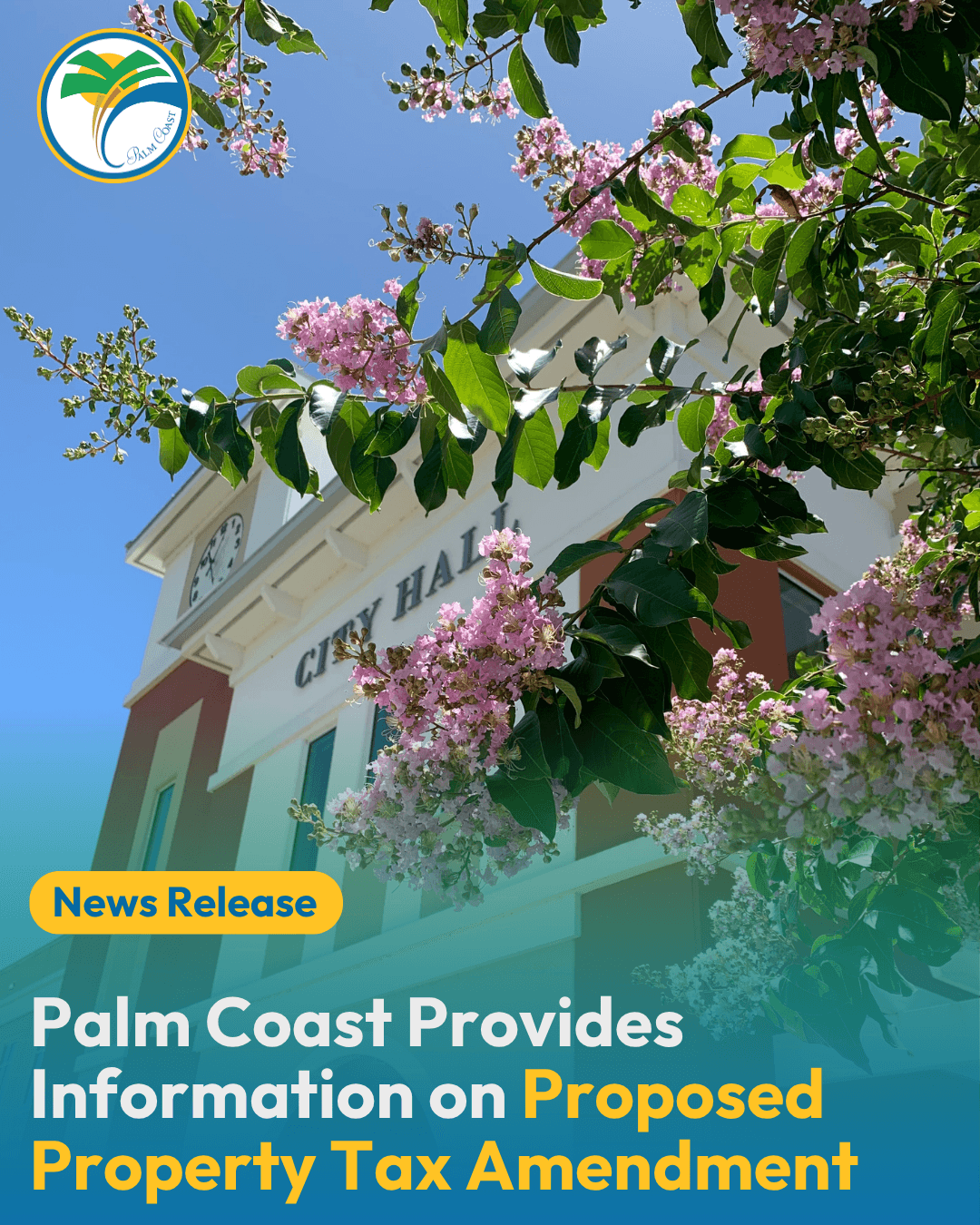
Palm Coast residents will decide this November on a constitutional amendment that could cut nearly half the city's property tax revenue within two years, forcing potential reductions in police, fire, parks, and other municipal services. The city has released financial projections showing the scale of the fiscal impact ahead of the November 3 General Election.
Florida's Amendment 3, which requires 60 percent voter approval to pass, would dramatically expand homestead exemptions and limit annual tax assessment increases on rental properties and other non-homestead real estate. The Florida League of Cities estimates Palm Coast would lose approximately $12. 4 million in property tax revenue in 2027 and $21. 7 million in 2028 if the measure takes effect.
What's on the ballot
Amendment 3 would make three major changes to Florida's property tax structure. First, it would increase the homestead exemption for non-school taxes from $50,000 to $150,000 starting in 2027, then to $250,000 beginning in 2028. Homestead exemptions allow primary-residence owners to shield a portion of their property's assessed value from taxation.
Second, the amendment would cut the annual assessment increase cap for non-homestead properties from 10 percent to 5 percent. Under Florida's Save Our Homes law, homesteaded properties already enjoy a 3 percent annual assessment cap; this change would extend similar protection to rental homes, second homes, commercial properties, and other non-homestead real estate.
Third, the measure would impose additional restrictions on how local governments may use property tax revenue, though the city's notice does not detail those restrictions.
The 2026 General Election is November 3, 2026. Constitutional amendments in Florida require at least 60 percent voter approval to become law.
The budget math
Property taxes represent a substantial portion of Palm Coast's operating budget. Ad valorem property taxes—the annual levy based on assessed real estate value—fund approximately $45. 5 million of the city's General Fund, which supports fire services, law enforcement, street maintenance, parks, recreation, city administration, and community development.
The projected $21. 7 million reduction in 2028 would equal nearly 48 percent of the city's current property tax revenue. For context, Palm Coast budgeted approximately $15. 2 million for fire services and $11 million for law enforcement in fiscal year 2026, a combined total of $26. 2 million. The second-year revenue loss under Amendment 3 would approach the city's entire public-safety budget.
These figures are projections from the Florida League of Cities and the actual impact could vary depending on growth in the tax base, changes in assessed values, and shifts in the mix of homesteaded versus non-homesteaded properties. Still, the order of magnitude is clear: Amendment 3 would represent the largest single budget shock in Palm Coast's recent history.
The city has emphasized that no decisions have been made regarding service reductions or other changes. Officials stated there is no single revenue source currently available that would fully replace a loss of this magnitude, and addressing the shortfall could require a combination of budget adjustments, spending reductions, fees, and other legally authorized revenue options.
What it means for city services
A reduction of this scale would force Palm Coast to make difficult choices about service levels in a city that has grown rapidly in recent years. Flagler County, where Palm Coast is the largest municipality, has been among Florida's faster-growing regions, with new residential development steadily adding demand for roads, parks, utilities, and emergency response.
Public safety would face particular scrutiny. Fire and law enforcement together account for more than half the city's General Fund expenditures, and both are services where staffing levels and response times are visible, measurable, and closely watched by residents. Reducing public-safety budgets typically means fewer firefighters per shift, longer police response times, deferred equipment purchases, or delayed station openings in growing areas.
Beyond emergency services, the revenue loss could affect road resurfacing schedules, park maintenance, recreation programming, code enforcement, and planning staff who review development applications. Capital projects—new facilities, major road work, stormwater upgrades—would also compete for scarcer dollars. In a growth market, deferred infrastructure can compound over time, as roads deteriorate faster than they can be rebuilt and park acres per capita decline.
The city has stated it will evaluate its budget, service levels, capital plans, and legally available revenue options if the amendment passes. Under Florida law, municipalities have limited tools to raise revenue. They may adjust millage rates within statutory caps, but if the tax base shrinks due to expanded exemptions, higher rates applied to a smaller base may not close the gap. They may impose or increase fees for specific services—permitting, recreation programs, solid waste collection—but fee revenue is typically tied to cost recovery for those services, not general-fund operations. Some cities have turned to local-option sales taxes or special assessments, but those require voter approval or apply only to defined projects.
The lack of a ready replacement revenue source means that budget cuts would likely be part of any response. Whether those cuts come through hiring freezes, service reductions, or elimination of programs would depend on policy choices made by the city council in future budget cycles.
Impact on property owners and the tax base
For Palm Coast homeowners with homestead exemptions, Amendment 3 would deliver immediate savings. A home with a taxable value of $300,000 (after existing exemptions) would see an additional $100,000 shielded from city and county taxes in 2027, and $200,000 in 2028. At Palm Coast's current millage rate, that translates to hundreds of dollars in annual savings per household.
The cap on non-homestead assessment increases would benefit owners of rental properties, vacation homes, and commercial real estate. Currently, these properties can see assessed values rise up to 10 percent per year, even if market values climb more sharply. Lowering the cap to 5 percent would slow the growth of tax bills for landlords and business owners, but it would also lock in a slower rate of revenue growth for the city—especially important in a place where new apartments, retail centers, and industrial projects are adding to the tax rolls.
The structure of Amendment 3 creates a dynamic in which a larger share of the tax base is insulated from annual increases, leaving a smaller pool of properties to absorb the cost of city services. In practice, this can lead to upward pressure on millage rates over time, as cities and counties try to maintain revenue by taxing the remaining assessable base more heavily. New homebuyers—those without years of Save Our Homes protection—and newer commercial properties could face higher effective rates as a result.
The amendment would also affect how Palm Coast competes for new residents and businesses. Lower property taxes may attract retirees and remote workers, but reduced city services—fewer parks, slower road repairs, longer emergency response times—can diminish quality of life and property values over the medium term. Commercial and industrial prospects often weigh infrastructure quality, public safety, and permitting capacity alongside tax rates when choosing a location.
What happens next
Palm Coast residents will vote on Amendment 3 on November 3, 2026. The measure is a statewide constitutional amendment, so the outcome will be determined by Florida voters collectively, not by Palm Coast alone. If at least 60 percent of voters statewide approve the amendment, it will take effect and local governments across Florida will begin implementing the new exemptions and caps in 2027.
The city has stated it is analyzing potential financial impacts and preparing for different scenarios. If the amendment passes, city staff will bring options to the city council during the next budget cycle, likely in the spring and summer of 2027 as officials prepare the fiscal year 2028 budget. Public hearings on the budget are required under Florida law, and residents would have opportunities to weigh in on any proposed service changes, fee increases, or millage adjustments.
In the meantime, the city has posted additional information about Amendment 3 and its local implications at palmcoast. gov/2026-florida-amendment-3. The city emphasized that it is providing the information for educational purposes and does not advocate for or against the measure.
Palm Coast's fiscal challenge mirrors a broader tension across Northeast Florida and the state: how to fund growing infrastructure and service demands in communities built on the promise of low taxes and affordability. As the First Coast continues to add thousands of new residents each year, the region's cities and counties are navigating the arithmetic of growth—more rooftops generate more revenue, but they also demand more roads, more classrooms, more water mains, and more fire stations. Amendment 3 would tilt that equation sharply, testing whether Florida's fast-growing cities can maintain the services that make growth sustainable when a large share of the tax base is shielded from the cost.
Sources
- City of Palm Coast: Palm Coast Provides Information on Proposed Property Tax Amendment