
Rolling Sands Drive in Palm Coast to Close for Stormwater Repairs
A stretch of Rolling Sands Drive near 118 Rolling Sands Drive will be closed for up to five days while crews replace underground stormwater pipes, with detours routing traffic through surrounding residential streets.
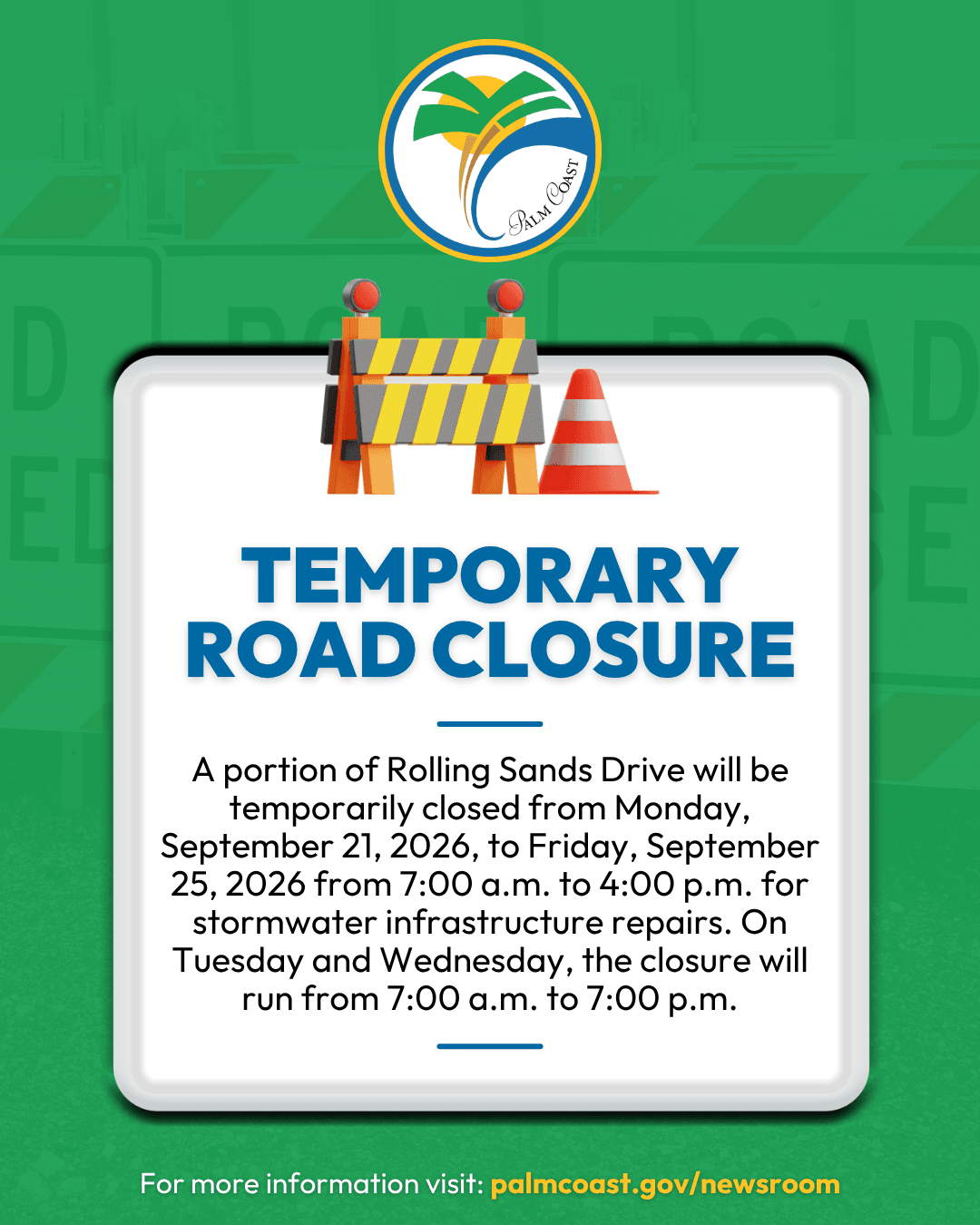
The City of Palm Coast will close a section of Rolling Sands Drive for most of the week of September 21 while crews repair and replace underground stormwater pipes, forcing drivers to detour through the surrounding residential grid.
The closure will affect the stretch near 118 Rolling Sands Drive from Monday, September 21, through Friday, September 25, though hours will vary and the city has warned that some overnight closures may be necessary.
What's happening
Palm Coast public works crews will close Rolling Sands Drive to through traffic from 7 a. m. to 4 p. m. on Monday, Thursday, and Friday. On Tuesday and Wednesday, the closure will extend from 7 a. m. to 7 p. m., with possible overnight closures during those two days, according to the city's announcement.
The work involves repairing and replacing underground stormwater pipes in the area. Residents who live in the affected section will still be able to reach their homes during construction hours, the city said.
Drivers traveling northwest on Rolling Sands Drive will be detoured onto Rymfire Drive and Ruth Drive. Drivers heading in the opposite direction—southeast—will be detoured using Ravenwood Drive. The city will post signs to guide drivers around the work zone.
Additional traffic signs will be placed near the intersection of Rolling Sands Drive and Royal Oak Drive to alert drivers that the road is closed ahead and that no through traffic will be allowed.
The city is asking drivers to use caution and allow extra travel time while the work is underway.
Impact on local traffic and commuters
Rolling Sands Drive serves as a connector through Palm Coast's R Section, a residential neighborhood in the city's northwest quadrant near the city limits with Bunnell. The five-day closure will push through traffic onto Rymfire Drive, Ruth Drive, and Ravenwood Drive—smaller residential streets not typically used as through routes.
The detours may add several minutes to trips for drivers who normally use Rolling Sands Drive to cut through the neighborhood, and residents on the detour streets can expect higher traffic volumes during the morning and late-afternoon periods when the road is closed. The city has not indicated whether traffic-calming measures will be in place on the detour routes.
Because local access will be maintained, residents living near 118 Rolling Sands Drive will still be able to come and go, though they may face short delays while construction equipment is moved or during active pipe-laying operations. The extended hours on Tuesday and Wednesday—7 a. m. to 7 p. m. —and the possibility of overnight closures those two nights suggest the most intensive work will occur midweek.
Drivers who commute from the R Section toward Old Kings Road, Cypress Point Parkway, or Palm Coast Parkway will need to plan alternate routes or add buffer time, particularly during the longer closure windows.
Why stormwater infrastructure matters in Palm Coast
Stormwater management is a constant challenge in Florida's coastal cities, where low-lying topography, sandy soils, and heavy seasonal rainfall create flood risks if drainage systems fail or become clogged. Palm Coast, built largely on former timberland in Flagler County, relies on an extensive network of underground pipes, roadside swales, retention ponds, and canals to move stormwater away from homes and streets and into larger drainage systems that eventually discharge into tidal creeks and the Intracoastal Waterway.
When stormwater pipes deteriorate—whether from age, ground settlement, tree-root intrusion, or sediment buildup—they can cause localized flooding during heavy rains, undermining roads and creating standing water that breeds mosquitoes and damages landscaping. Proactive replacement of failing pipes helps prevent emergency repairs that would require longer closures and cost more to address after a pipe collapses.
The city did not specify the age of the pipes being replaced on Rolling Sands Drive, but much of Palm Coast's R Section was developed in the 1980s and 1990s as part of ITT Community Development Corporation's master-planned buildout. Pipes installed during that era are now reaching the end of their design life, and the city has been gradually replacing aging stormwater infrastructure across older neighborhoods.
Stormwater upgrades are typically funded through the city's stormwater utility fee, which appears as a separate line item on residents' utility bills and is based on the amount of impervious surface—roofs, driveways, patios—on each property.
What happens next
The closure is scheduled to begin Monday, September 21, and run through Friday, September 25. Barring weather delays or unforeseen complications underground, the city expects to reopen Rolling Sands Drive to through traffic by the end of the week.
Residents and commuters should watch for detour signs and expect intermittent flagging operations near the work zone. The city has asked drivers to slow down and watch for workers and equipment.
Palm Coast's public works department posts updates on road closures and construction projects on the city's social media channels and through the city manager's weekly email newsletter, available at www. palmcoastgov. com.
Palm Coast's aging infrastructure challenge
The Rolling Sands Drive closure is a small but telling snapshot of the infrastructure maintenance burden facing Palm Coast and other Northeast Florida cities as subdivisions built during the region's first growth wave age into their fourth decade.
Across Flagler County, cities and the county government are balancing the costs of maintaining and upgrading pipes, roads, and stormwater systems installed in the 1980s and 1990s while also building new infrastructure to support continued residential growth. Palm Coast's population has grown from roughly 32,000 in 2000 to more than 100,000 today, and the city has annexed thousands of acres on its western edge, adding demand for new roads and utilities even as older systems require replacement.
Short-term closures for pipe repairs are a routine part of that equation, a price residents pay for living in a city where much of the underground infrastructure is invisible until it fails. The goal of proactive replacement projects like the one on Rolling Sands Drive is to keep those failures rare—and the closures planned rather than emergency responses.
Sources
- City of Palm Coast: City of Palm Coast Announces Temporary Road Closure on Rolling Sands Dr.