
St. Johns County adopts $1.9B budget with $100M on hold for Amendment 3
The county froze capital projects and prepared $61.2 million in extra reserves as it braces for potential property-tax cuts that could hit $191 million annually if voters approve the November ballot measure.
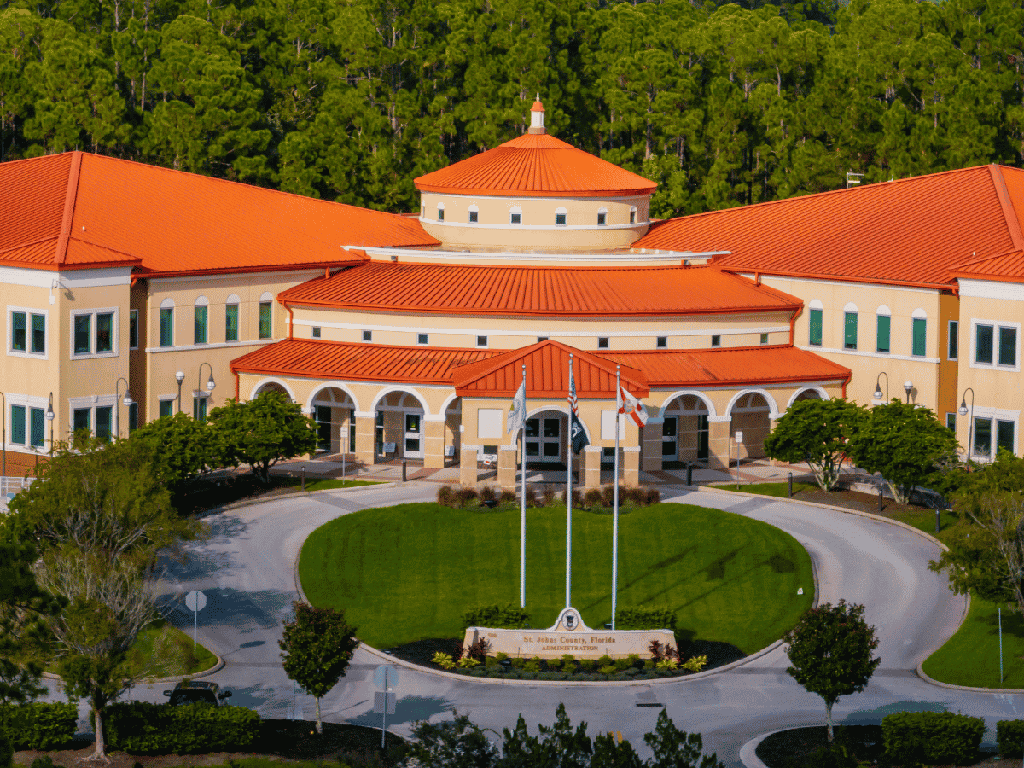
The St. Johns County Board of County Commissioners adopted a $1.9 billion budget for Fiscal Year 2027 on September 15, 2026, but with an unusual safeguard: $100 million in capital improvement projects placed on hold and more than $61 million in additional reserves set aside in case voters approve a sweeping property-tax amendment in November.
The budget maintains flat millage rates from the prior year while preparing for potential revenue losses the state estimates could reach $191.6 million annually by 2032 if Property Tax Amendment 3 passes on the November 3, 2026, General Election ballot. In addition to freezing $100 million in capital spending, the county identified approximately $8.6 million in positions and vacant-position funding for reassessment after the election outcome is known.
What's in the $1.9 billion budget
The Fiscal Year 2027 budget includes more than $264 million in new funding for capital improvement projects — though which projects move forward will depend on the election results. The county is also borrowing approximately $126.3 million for utility services capital improvements.
Key budget commitments include funding for new facilities such as parks, libraries, and fire stations, as well as roadway improvements across the fast-growing county. The county kept its millage rate flat compared to FY 2026, continuing a long-term pattern: St. Johns County maintained flat millage rates from FY 2012 through FY 2020, reduced rates during the COVID-19 pandemic in FY 2021, and achieved a net millage reduction in FY 2026.
The budget strengthens county reserves with $31.2 million added to emergency response reserves and an additional $30 million placed in General Fund reserves specifically designated for financial resiliency in response to Amendment 3. Emergency response reserves were increased for the General Fund and newly added for both the Transportation Trust and Fire District Fund, reflecting the county's preparation for fiscal uncertainty.
The county has been preparing for the potential fiscal effects of the proposed property tax amendment since May 2026. To inform residents, officials hosted a town hall on September 29, produced a four-part County Conversations podcast series, and provided a budget overview and amendment update during the September 1, 2026, Board of County Commissioners regular meeting. A dedicated webpage at sjcfl. us/amendment-3 offers an overview of the proposed amendment, estimated revenue effects, current allocation of property tax dollars, and links to official sources.
What Amendment 3 could mean for county revenue
According to the Florida Office of Economic and Demographic Research, if Amendment 3 passes, St. Johns County could see estimated property tax revenue reductions of $68.3 million in FY 2028, $136.1 million in FY 2029, and $191.6 million by FY 2032. The county does not advocate for or against the amendment; its stated responsibility is to provide factual information to residents and prepare for either outcome.
The scale of those potential cuts is significant for a county that has been among Florida's fastest-growing and relies on property tax revenue to fund the infrastructure, schools, public safety, and services that growth demands. Property taxes fund a wide range of county operations, from road maintenance and fire protection to parks, libraries, and administrative staff.
By placing $100 million in capital projects on hold, the county is effectively creating a firewall: if the amendment fails, those projects can proceed as planned. If it passes, the county will have avoided committing to multi-year construction contracts it might struggle to pay for under a sharply reduced revenue picture. Capital improvement projects typically include road widenings, park construction, fire station builds, library expansions, and utility infrastructure — all of which require not just upfront construction dollars but ongoing operational and maintenance funding once complete.
How the $100 million freeze affects infrastructure and growth
The decision to freeze $100 million in capital projects has direct implications for how quickly St. Johns County can keep pace with its explosive residential growth. The county routinely ranks among the fastest-growing in Florida, with thousands of new housing units delivered each year in master-planned communities such as Nocatee, SilverLeaf, and RiverTown, and along the CR 210 and SR 16 corridors.
Each new neighborhood increases demand for roads, parks, libraries, fire stations, and stormwater infrastructure. Delaying capital projects can mean longer waits for road improvements that ease congestion, postponed openings of parks and recreation facilities that serve new subdivisions, and deferred fire station construction that affects emergency response times in growing areas.
For residents and developers, the $100 million hold introduces uncertainty about the timeline for planned improvements. Developers often coordinate project phasing with anticipated county infrastructure; delays in county road widenings or utility extensions can cascade into private-sector construction schedules. Homebuyers evaluating new communities may find that amenities or traffic relief they expected will take longer to materialize if the amendment passes and the county must stretch its reduced revenue across competing priorities.
The $8.6 million in positions and vacant-position funding identified for reassessment adds another layer of uncertainty for county operations. While the county has not specified which positions are under review, staffing cuts or hiring freezes could affect service delivery across departments — from permitting and code enforcement to parks maintenance and library hours. In a county adding population as quickly as St. Johns, even holding staffing flat while the population grows effectively means fewer employees per resident.
What strengthened reserves mean for county resilience
The county's decision to add $61.2 million to reserves — $31.2 million in emergency response reserves and $30 million in general financial resiliency reserves — reflects a strategy of building a financial cushion before potential revenue cuts take effect. Emergency reserves are typically used to respond to hurricanes, floods, and other disasters without disrupting regular operations or waiting for state and federal reimbursements, which can take months or years.
Expanding emergency reserves for the General Fund and adding them for the Transportation Trust and Fire District Fund gives the county more flexibility to address storm damage, debris removal, and emergency repairs without immediately cutting services elsewhere. In a coastal county with significant flood risk along the Intracoastal Waterway, the St. Johns River, and Atlantic beaches, those reserves are a practical hedge against both natural disasters and the fiscal uncertainty introduced by the proposed amendment.
The $30 million in General Fund reserves designated specifically for financial resiliency in response to Amendment 3 functions as a bridge fund. If the amendment passes and revenue cuts begin in FY 2028, the county will need time to adjust budgets, renegotiate contracts, and decide which services to scale back. The extra reserves buy that time, allowing the county to avoid immediate layoffs or abrupt service cuts while it recalibrates operations to a lower revenue baseline.
For taxpayers, the strengthened reserves offer stability: the county is less likely to face a fiscal crisis that forces sudden, deep cuts to public safety, road maintenance, or other core services. However, reserves are a one-time resource. Once spent, they do not recur. If Amendment 3 passes and the revenue losses are as large as the state projects, the county will eventually need to make structural adjustments — either cutting spending, raising other revenues, or some combination — that reserves alone cannot solve.
What property owners and taxpayers should know
St. Johns County property owners will see a flat millage rate for FY 2027, meaning the tax rate itself is unchanged from the prior year. However, property tax bills are a product of the millage rate and the assessed value of a property. In a high-appreciation market like St. Johns County, many homeowners will still see higher tax bills in FY 2027 if their assessed values rose, even though the county did not raise the rate.
The long-term question for property owners is what happens if Amendment 3 passes. While the amendment is designed to reduce property taxes for homeowners, the corresponding revenue loss to local governments could force difficult tradeoffs: slower road improvements that leave traffic congestion unaddressed, fewer parks and libraries in growing areas, or potential increases in fees and assessments to offset lost property tax revenue. Florida counties are limited in their revenue tools — they cannot levy income or sales taxes without state authorization — so property tax cuts often translate directly into reduced public investment.
For prospective homebuyers, the county's fiscal posture is part of the broader value equation. St. Johns County's appeal has long rested on a combination of top-rated schools, new infrastructure, abundant parks and recreation, and relative affordability compared to coastal South Florida. If reduced revenue slows the county's ability to build the infrastructure and amenities that have accompanied growth, that value proposition could shift. Buyers considering new construction in communities along CR 210 or SR 16 may want to monitor which road projects and park plans are on the $100 million hold list.
Developers and contractors should note that the $100 million in paused projects represents potential work that may or may not proceed depending on the November election outcome. If the amendment fails, those projects are likely to move forward in FY 2027 or FY 2028. If it passes, the county will need to re-evaluate priorities and timelines, and some projects may be delayed for years or canceled outright.
What happens next
The November 3, 2026, General Election will determine whether Property Tax Amendment 3 becomes law. If the amendment passes, the county will begin experiencing revenue reductions starting in FY 2028, with the state estimating losses growing to $191.6 million annually by FY 2032.
Following the election, the county will reassess the $100 million in capital projects currently on hold and the $8.6 million in positions and vacant-position funding. If the amendment fails, staff and commissioners can move forward with the full capital program and hiring as budgeted. If it passes, the county will need to make decisions about which projects to advance, which to delay, and how to adjust staffing and service levels to match reduced revenue.
The county's FY 2027 budget and additional details are available at www. sjcfl. us/departments/office-of-management-and-budget. Information about Amendment 3, including estimated fiscal effects and current property tax allocations, is available at sjcfl. us/amendment-3.
St. Johns County's fiscal hedging reflects the balancing act facing Florida's growth counties: continuing to invest in the infrastructure that serves rapid population growth while preparing for a fiscal environment that may sharply constrain the revenue available to fund it. How voters decide on Amendment 3 will shape not just tax bills, but the pace and character of development across Northeast Florida for years to come.
Sources
- St. Johns County: St. Johns County Approves Fiscal Year 2027 Budget