
St. Johns County flag rescue program hits 31,000 flags since 2019
A volunteer-driven initiative founded by a county solid-waste staffer now operates more than 40 collection sites across St. Johns County, offering residents a respectful way to retire worn American flags.
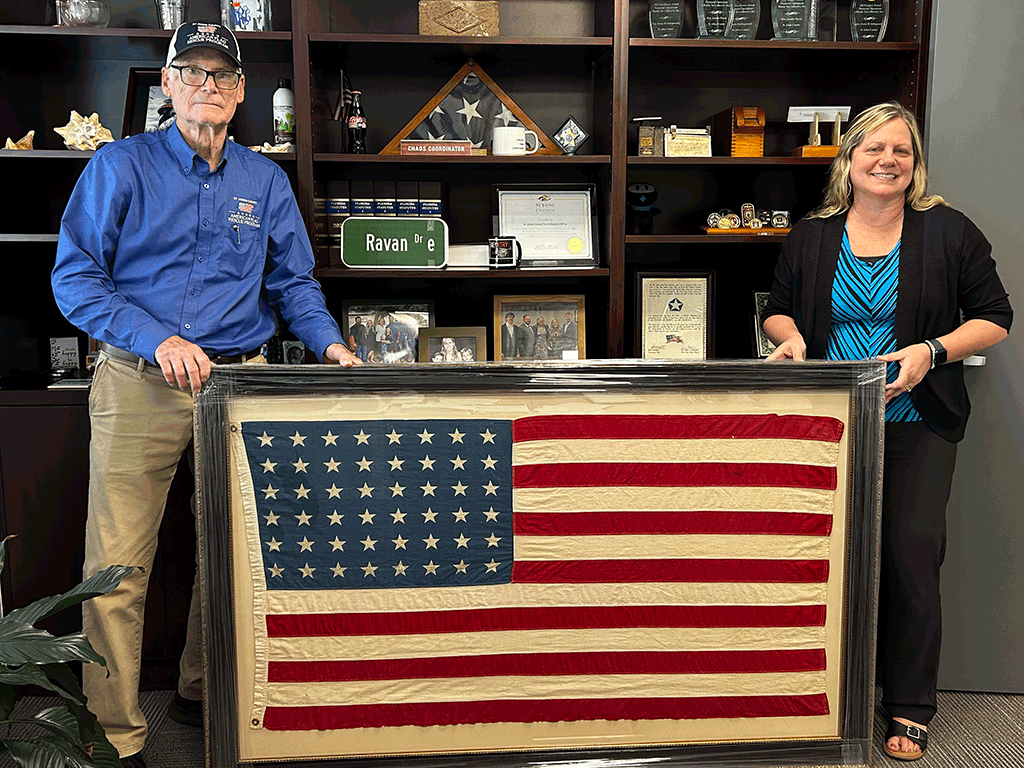
A seven-year effort to give St. Johns County residents a dignified way to retire worn or damaged American flags has passed a milestone of 31,000 flags collected, the county announced this week. The American Flag Rescue Program, founded in 2019 by Chris Benjamin of the county's Solid Waste Division, now operates collection boxes at more than 40 sites across the county.
Volunteers Viki and Mike Cofone collected the 31,000th flag in September from a collection box at the St. Johns County Tax Collector's Office in St. Augustine. To mark the occasion, county officials presented a framed 48-star flag—one previously rescued through the program—to Tax Collector Jennifer Ravan and her staff for public display at the St. Augustine annex.
What's happening
The American Flag Rescue Program was established in 2019 to provide residents with a respectful alternative to discarding flags in household trash. According to the county, the initiative has grown from its initial footprint to more than 40 collection locations, including government offices, libraries, local businesses, and community organizations throughout St. Johns County.
All four Tax Collector offices in the county host collection boxes: the main office at 4030 Lewis Speedway in St. Augustine, the St. Johns office at 725 Flora Branch Road, the Southeast office at 6670 U. S. 1 South in St. Augustine, and the Ponte Vedra Beach office at 151 Sawgrass Corners Drive.
Benjamin, who founded the program as part of his work with the county's Solid Waste Division, said in a statement that the milestone "reflects the care our residents have for the American flag and the commitment of the volunteers and community partners who make this program possible. " Volunteers like the Cofones sustain the program by picking up flags from participating locations on a regular basis.
The county noted that the program supports the St. Johns County Strategic Plan's Community Trust priority by encouraging volunteer service and resident participation. A complete list of drop-off locations is available on the county website at www. sjcfl. us/outreach. Questions can be directed to the Solid Waste Division at solidwaste@sjcfl. us or 904-827-6980.
How flag retirement works in practice
The county program addresses a practical gap many residents face: what to do with an American flag once it becomes too worn to display. Under the U. S. Flag Code—a set of federal guidelines dating to 1942—flags that are no longer fit for service should be retired "in a dignified way, preferably by burning. " The code carries no penalties but is widely followed as a standard of respect.
Organizations such as veterans' groups, Boy Scout and Girl Scout troops, and civic clubs typically conduct ceremonial flag retirements, often on Flag Day (June 14) or around Independence Day. These ceremonies involve folding the flag, sometimes cutting it into pieces so that the union (the blue field of stars) remains intact, and then burning the material in a respectful setting with a color guard or similar formality.
For individual residents, arranging such a ceremony can be impractical. Collection programs like St. Johns County's consolidate retired flags and coordinate with volunteers and partner organizations to carry out group retirements, ensuring flags are handled according to tradition without requiring each household to organize its own ceremony.
The American Flag Rescue Program's model—distributed collection sites paired with volunteer pickups—mirrors similar initiatives run by municipalities, veterans' organizations, and nonprofit groups across the country. By embedding drop boxes in high-traffic public buildings such as tax offices and libraries, the program lowers the barrier for participation.
What the milestone says about community engagement
The 31,000-flag total, accumulated over seven years, translates to an average of roughly 4,400 flags per year, or about 370 per month countywide. St. Johns County's population has grown rapidly during that period—the U. S. Census Bureau estimated the county's 2023 population at approximately 280,000, up from around 265,000 in 2020 and 190,000 in 2010.
The steady flow of retired flags into the program reflects both the county's growth and the breadth of its collection network. With more than 40 sites now participating, residents across communities from Ponte Vedra Beach to St. Johns and the rural western portions of the county have access to a nearby drop-off point.
Volunteer-driven programs of this type depend on a core group of committed participants willing to perform routine logistics—collecting flags, coordinating with host sites, and arranging retirements. The recognition given to the Cofones and to the Tax Collector's Office underscores the county's effort to sustain the program through public acknowledgment of contributors.
The presentation of the framed 48-star flag to the Tax Collector's St. Augustine annex serves a dual purpose: it honors a partner agency's role in the program and creates a visible artifact of the initiative in a public space. A 48-star flag would have been official between 1912 (when New Mexico and Arizona joined the Union) and 1959 (when Alaska was admitted), meaning the rescued flag on display is at least 67 years old.
How residents can participate
St. Johns County residents looking to retire an American flag can drop one off at any of the program's collection sites. The county maintains an updated list at www. sjcfl. us/outreach, spanning government buildings, libraries, and participating businesses and organizations.
The four Tax Collector offices provide particularly accessible options, with locations in St. Augustine (two offices), St. Johns, and Ponte Vedra Beach. These offices already draw high foot traffic for services such as vehicle registration, property-tax payments, and driver-license renewals, making flag drop-off a convenient add-on errand.
No advance notice or paperwork is required; residents simply place the flag in the designated collection box. Flags of any size are accepted, and they need not be in a particular condition beyond being too worn or damaged for continued display. The program does not collect non-fabric items such as flag poles or stands.
For residents interested in supporting the program beyond dropping off flags, the county's Solid Waste Division can be contacted about volunteer opportunities. Expanding the collection network to additional business or organizational partners is another way community members can extend the program's reach.
The broader context of growth and civic infrastructure
St. Johns County's rapid population growth over the past two decades has been accompanied by expanded public services and community programs. The county consistently ranks among Florida's fastest-growing, driven by highly rated schools, proximity to Jacksonville employment, and master-planned communities such as Nocatee and SilverLeaf.
As the population has swelled, county departments have scaled services to match. The Solid Waste Division, which oversees the flag rescue initiative, also manages curbside collection, recycling programs, and household hazardous-waste events—services that must keep pace with the addition of thousands of new rooftops each year.
Programs like the American Flag Rescue effort represent a relatively low-cost, high-visibility way for local government to foster civic engagement and volunteerism. By partnering with existing facilities—tax offices, libraries, businesses—the county avoids the capital expense of dedicated drop-off centers while still providing countywide access.
The 31,000-flag milestone, reached in the program's seventh year, suggests that both awareness and participation have grown alongside the county itself. As St. Johns continues to attract new residents, initiatives that build community identity and offer simple ways to participate in shared values are likely to remain a fixture of the county's civic landscape.
Sources
- St. Johns County: American Flag Rescue Program Celebrates 31,000 Flags Rescued