
St. Johns County sets $31M emergency reserve amid property-tax uncertainty
The county adopted a $1.9 billion budget for 2027 with strengthened reserves as a ballot amendment could cut property-tax revenue by as much as $191.6 million within six years.
Corrections
- Correction: Formatting was corrected in budget, reserve, revenue, radio-frequency, time and web-address references. The underlying figures and source did not change.
St. Johns County has adopted a $1.9 billion budget for fiscal year 2027 and is bolstering its financial reserves by more than $61 million, a defensive posture as a proposed property-tax amendment on the November ballot could force cuts of nearly $200 million a year within six years.
The county Board of County Commissioners approved the budget on September 15, 2026, during its second public hearing. The board held the millage rate flat and designated $31.2 million in emergency response reserves and an additional $30 million in General Fund reserves specifically to prepare for potential effects of Amendment 3, a statewide property-tax measure appearing on the November 3, 2026, general election ballot.
What's in the budget
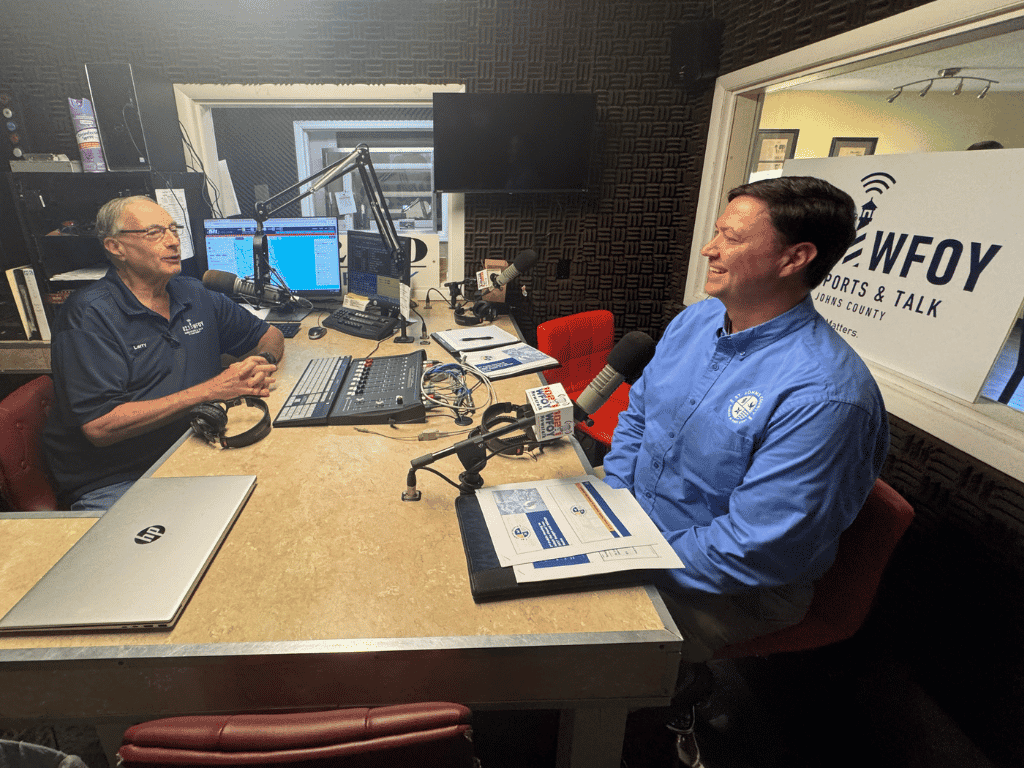
The $1.9 billion fiscal year 2027 spending plan represents the county's entire operating and capital budget across all funds. Wade Schroeder, director of the county Office of Management & Budget, discussed the budget's structure and revenue sources during the county's monthly radio show, The SJC Report, which aired October 13, 2026, on WFOY 102.1 FM.
The board approved a flat millage rate, meaning property owners will pay the same tax rate as the prior year. However, because property values have continued to rise in St. Johns County, total property-tax collections will increase even with a flat rate, as the tax base expands with new construction and higher assessed values.
The county has been preparing since May 2026 for the potential passage of Amendment 3. According to estimates from the Florida Office of Economic and Demographic Research cited by the county, the amendment could reduce St. Johns County property-tax revenue by $68.3 million in fiscal year 2028, $136.1 million in fiscal 2029, and $191.6 million by fiscal 2032.
The county set up a dedicated webpage at sjcfl.us/amendment-3 with details on the proposed amendment and its estimated revenue effects. Officials emphasize the county does not advocate for or against the measure; its role is to provide factual information to residents and prepare for either outcome.
What Amendment 3 means for county services
The reserve cushion approved in the 2027 budget is designed to give the county time and flexibility to respond if voters approve the amendment. Property-tax revenue is the largest single source of funding for county government operations, including public safety, infrastructure maintenance, parks, libraries, and administrative services.
A reduction of the magnitude projected by state researchers would require substantial adjustments to county operations. The $61.2 million in new reserves represents roughly one-third of the first-year revenue cut estimated for fiscal 2028 and a smaller fraction of the potential reductions in later years. Reserves can smooth the transition and delay immediate service cuts, but they are a one-time buffer; sustained revenue reductions typically require structural spending adjustments.
St. Johns County has experienced rapid population growth over the past decade, consistently ranking among Florida's fastest-growing counties. That growth has driven increased demand for county services, from road maintenance and traffic management to expanded parks and public-safety staffing. The county funds much of that expansion through property taxes on new development and rising property values. If Amendment 3 passes, the county would face the challenge of maintaining services for a growing population with a shrinking revenue base.
The county hosted a town hall on September 29, 2026, and produced a four-part podcast series to inform residents about the amendment and its potential fiscal effects. Schroeder provided a budget overview and an update on property-tax reform during the September 1, 2026, regular meeting of the Board of County Commissioners.
How the amendment would affect taxpayers and growth
Amendment 3 is a statewide measure, and its passage would affect all Florida counties, though the dollar impact varies by local property values and tax rates. St. Johns County's high property values and strong real-estate market mean the absolute dollar reductions would be among the largest in Northeast Florida, even though the county's millage rate is relatively moderate.
For individual property owners, the amendment is intended to reduce property-tax bills. The precise effect on any household depends on the property's assessed value, existing homestead exemptions, and local millage rates. The county has not published taxpayer-level estimates, focusing instead on the aggregate revenue impact to the county budget.
The interplay between tax policy and growth is a key uncertainty. St. Johns County's appeal to new residents and businesses rests in part on its combination of top-rated schools, quality-of-life amenities, and manageable tax rates. If the county were forced to cut services or raise other fees to offset property-tax losses, that competitive position could shift. Conversely, lower property taxes might make the county more attractive to buyers and investors, potentially accelerating growth and partially offsetting the revenue loss through volume.
Development activity in the county has remained robust, with major master-planned communities such as Nocatee and SilverLeaf continuing multiyear buildouts and the CR 210 and SR 16 corridors adding commercial and residential projects. How—or whether—Amendment 3 alters that trajectory will depend on both voter decisions in November and the county's policy response if the measure passes.
What happens next
The election is scheduled for November 3, 2026. If Amendment 3 passes, the revenue reductions would begin in fiscal year 2028, giving the county roughly one budget cycle to prepare detailed spending adjustments. The reserves approved in the fiscal 2027 budget are specifically designated to provide financial resiliency in that scenario.
County budget documents and additional detail on the fiscal 2027 spending plan are available at sjcfl.us/departments/office-of-management-and-budget. The SJC Report airs on the second Tuesday of each month at 8 a.m. on WFOY 102.1 FM, and archived episodes are available on the county's podcast page.
St. Johns County's budget maneuvering reflects the broader tension Northeast Florida counties face as they absorb rapid growth while navigating state-level tax and revenue policies. Whether voters approve Amendment 3 or not, the county's decision to build reserves and prepare contingency plans signals that fiscal caution is now a feature of the region's breakneck expansion.
Sources
- St. Johns County: The SJC Report Features Budget Director