
St. Johns County video series wins state award for public engagement
The SJC Stewardship Series has drawn nearly 200,000 views since July by connecting residents with local history, conservation sites, and public lands across the county.
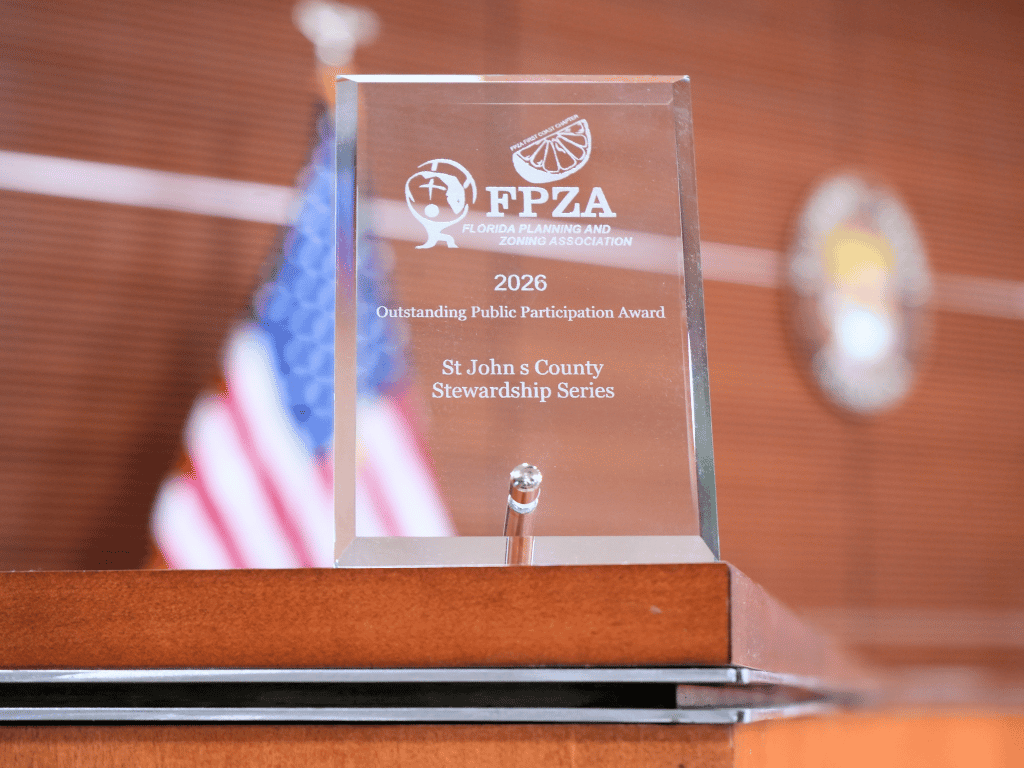
A St. Johns County video series spotlighting local history, conservation, and public lands has earned statewide recognition for its approach to connecting residents with the places that define the county's identity. The SJC Stewardship Series received the 2026 Outstanding Public Participation Award from the Florida Planning and Zoning Association's First Coast Chapter at the organization's annual banquet in Jacksonville on November 5.
Since launching in July 2026, the monthly series has released five regular episodes and one special episode, generating nearly 200,000 views and 10,000 engagements across all platforms. The episodes are produced through a collaboration between the St. Johns County Office of Public Affairs, Parks & Recreation, Growth Management, and community partners.
What's happening
The Outstanding Public Participation Award recognizes the series for its use of digital storytelling, interdepartmental collaboration, and community partnerships to expand public understanding of the places and resources that shape St. Johns County, according to the county's announcement.
Featured locations have included Fort Matanzas National Monument, Castillo de San Marcos National Monument, Alpine Groves Park, Beluthahatchee Park, and Fort Mose Historic State Park. Each episode is developed with input from historians, environmental professionals, site managers, community partners, and subject-matter experts.
Matthew Denny, Digital Media Manager with the St. Johns County Office of Public Affairs and producer for the series, said the recognition was an honor. "We love creating these videos and hope they inspire residents and visitors to appreciate and protect the incredible historic places we have here in St. Johns County," Denny said in the announcement.
Megan Wright, an Environmental Specialist with Growth Management who serves as on-camera host, explained the series' purpose: "Our goal is to highlight how historic preservation, conservation, public acquisition, restoration, partnerships, and thoughtful land management work together to protect the places residents enjoy today. "
Episodes are available on the county's social media channels—Facebook, Instagram, X, YouTube, and LinkedIn—as well as a dedicated web page and the county's GovTV channel. New episodes are released monthly, with each highlighting a different location.
Why public engagement matters in a fast-growth county
St. Johns County is among Florida's fastest-growing counties, a distinction that puts pressure on its natural areas, historic sites, and rural character. As subdivisions spread along the CR 210 corridor, Nocatee, SilverLeaf, and the SR 16 corridor near World Golf Village, public understanding of conservation and preservation becomes material to future land-use decisions.
Planning and zoning processes in Florida require public participation for major rezonings, comprehensive-plan amendments, and development orders, but turnout and understanding often lag. Video storytelling offers a channel for county staff to build familiarity with the county's existing conservation and historic assets before those assets become contested in development applications.
When residents understand how sites like Beluthahatchee Park or Alpine Groves Park came into public ownership—often through negotiated acquisitions, partnerships, or restoration of degraded land—they have context for evaluating future proposals to conserve or develop nearby parcels. That context is especially valuable in St. Johns County, where master-planned communities and infill projects routinely trigger debates over greenspace, tree canopy, and access to natural areas.
The series' interdepartmental collaboration—linking Public Affairs, Parks & Recreation, and Growth Management—signals an effort to integrate public communication into the county's growth-management function, rather than treating outreach as an afterthought. Growth Management staff in Florida counties administer comprehensive plans, review development applications for compliance, and coordinate environmental permits; having that office collaborate on public storytelling can help residents see how regulatory decisions connect to the places they use.
How digital engagement shapes local planning
The nearly 200,000 views and 10,000 engagements represent a scale of reach that far exceeds attendance at a typical planning commission hearing or public workshop. For a county whose population surpassed 273,000 in recent Census estimates, digital video offers a way to inform a broad audience without requiring them to attend evening meetings or parse technical staff reports.
The Florida Planning and Zoning Association, which presented the award, is a professional group whose members include county and municipal planners, zoning officials, and consultants. The Outstanding Public Participation Award is one of several the organization presents annually to recognize innovation in public engagement, plan implementation, and community development across the state.
By honoring the Stewardship Series, the FPZA has effectively endorsed video storytelling as a legitimate tool for meeting Florida's public-participation mandates—an approach other local governments in the region may adopt. Traditional public-notice methods, such as newspaper advertisements and mailed postcards, often fail to generate meaningful participation, particularly among younger residents or those new to the area.
St. Johns County's series also highlights a growing practice among local governments: leveraging social-media platforms owned by private companies—Facebook, Instagram, YouTube—to fulfill public-information responsibilities. This raises questions about equitable access for residents without internet service or social-media accounts, though the county also distributes episodes via its GovTV channel and website.
What the series tells us about county priorities
The five featured locations—Fort Matanzas, Castillo de San Marcos, Alpine Groves Park, Beluthahatchee Park, and Fort Mose—span National Park Service sites, county parks, and state historic parks. The selection reflects both the county's Spanish colonial heritage and its more recent investments in park acquisition and greenspace preservation.
Alpine Groves Park, a county-owned site in the southwestern part of St. Johns County, was acquired and restored from former agricultural land. Beluthahatchee Park, also county-owned, lies along the Intracoastal Waterway and features salt marsh and upland habitats. Both parks represent the type of conservation acquisition that competes with residential development in a high-growth market.
Fort Mose, located just north of St. Augustine, was the first legally sanctioned free Black settlement in what is now the United States, established in 1738. Its inclusion in the series underscores the county's attention to African American history alongside the more widely marketed Spanish colonial narrative.
By pairing historic sites with natural areas, the series frames preservation and conservation as complementary rather than separate planning goals. This framing has practical implications: when the county considers whether to support state or federal land acquisitions, or whether to approve development near sensitive sites, public familiarity with existing preserved lands can influence the political calculus.
The series' emphasis on "thoughtful land management" and partnerships also reflects ongoing tensions in Florida growth policy. St. Johns County, like much of Northeast Florida, relies on a mix of regulatory tools—comprehensive plans, concurrency requirements, environmental permits—and voluntary partnerships with land trusts, state agencies, and federal monument managers to balance growth and conservation. How well that balance holds as the county adds tens of thousands of new residents will depend in part on whether the public values the assets the series highlights.
What happens next
New episodes are scheduled for release monthly, with each installment highlighting a different location and theme. The county has not disclosed a full production schedule or how many episodes are planned, but the format suggests an ongoing series rather than a limited run.
Residents can follow the series by subscribing to the county's social media channels or visiting the dedicated SJC Stewardship web page. Episodes are also available on the county's GovTV channel, which is accessible via the county website and local cable systems.
The Florida Planning and Zoning Association's recognition may prompt other Northeast Florida counties—Duval, Clay, Nassau—to explore similar video initiatives. Clay County, which is experiencing rapid growth along the First Coast Expressway corridor, and Nassau County, where development is concentrated around Wildlight and the SR 200 corridor, face many of the same public-engagement challenges that St. Johns County set out to address with the Stewardship Series.
For St. Johns County, the series represents a bet that informed residents will be more effective stewards of the county's character as growth continues. Whether that bet pays off will become clearer in the years ahead, as new development proposals test the county's commitment to the landscapes and landmarks the series celebrates.
Sources
- St. Johns County: SJC Stewardship Series Earns 2026 Outstanding Public Participation Award