Duval County Public Schools opens annual survey to families through Oct. 23
The district's Data Triangle Survey asks students, staff, families, and community members to weigh in on school culture, safety, communication, and support services through October 23.
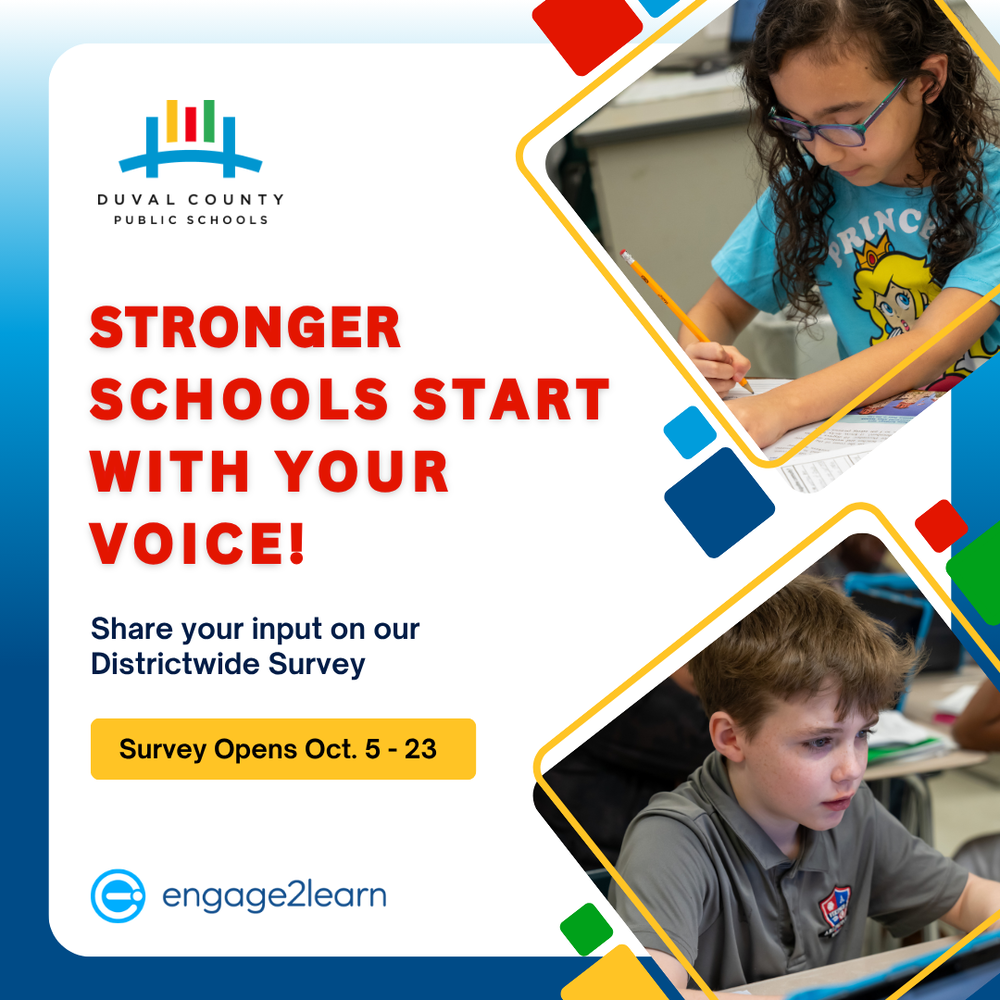
Duval County Public Schools is asking parents, students, staff, and community members to share their perspectives on district schools in an annual survey that opened October 5 and runs through October 23.
The Data Triangle Survey, available at www. duvalschools. org/surveys, gathers feedback on teaching and learning, school culture and safety, communication, family engagement, and student support services. The district says the results will be used alongside other data to help school and district leaders identify strengths and areas for improvement.
What's happening
The 2026 Data Triangle Survey opened October 5, 2026, and will remain open through October 23, 2026. Students in grades 4 through 12, all district staff, families, caregivers, and community members are eligible to participate.
The survey is confidential. Individual responses are not shared with district leaders; the district receives only aggregated information about respondent groups—whether participants are students, employees, family members, or community members.
The survey covers five broad categories: teaching and learning; engagement and family or community partnerships; school culture and safety; communication; and student and family support.
Results will be combined with other school and district data to provide what the district calls a more complete picture of experiences and needs across Duval County schools. District officials say the feedback will help leaders celebrate successes, strengthen existing practices, and better support students, families, and employees.
Why parent and community feedback matters for school decisions
Annual surveys like the Data Triangle have become a standard practice in Florida school districts, where accountability systems and school-grading formulas place increasing emphasis on parent satisfaction and non-academic indicators alongside test scores. In Duval County, where enrollment has hovered near 127,000 students across more than 160 schools, capturing representative feedback across diverse neighborhoods and school types is a persistent challenge for district planners.
The timing of the survey—early in the school year—means responses will reflect first impressions of new policies, staffing, and programs rolled out in August and September. For families, that could include changes to school start times, new transportation routes, technology rollouts, or safety protocols introduced at the beginning of the 2026–27 academic year.
Feedback on school culture and safety is particularly relevant in a district that has invested heavily in security infrastructure, school resource officers, and mental-health support over recent years. Survey responses can help administrators understand whether those investments are visible and effective in the eyes of students and families, or whether concerns persist about bullying, discipline practices, or crisis response.
How survey data shapes district priorities and resource allocation
School districts in Florida typically use survey results to guide strategic planning, allocate professional-development resources for teachers, and adjust support services. If large numbers of families report communication gaps, for example, principals and district staff may prioritize translation services, parent-engagement events, or improvements to the district's mobile app and website.
In Duval County, the survey's focus on family and community partnerships is significant given the district's ongoing efforts to boost parent involvement in schools with historically low participation rates. Results broken down by school or feeder pattern can reveal pockets of strong community trust and areas where outreach efforts have yet to gain traction.
Student responses from grades 4 through 12 offer a window into school climate that adults may not see. Elementary students can flag issues with cafeteria wait times, playground supervision, or classroom behavior; middle and high school students may raise concerns about course offerings, extracurricular access, or whether they feel supported by counselors and teachers as they prepare for college or careers.
Because survey participation is voluntary, response rates matter. Schools and principals often encourage families to complete the survey through robocalls, emails, text messages, and flyers sent home in backpacks. Higher participation improves the reliability of the data and reduces the risk that feedback skews toward only the most engaged—or most frustrated—families.
What the district does with the results
Duval County Public Schools has committed to using the survey results alongside achievement data, attendance rates, discipline records, and other metrics to assess school performance and district needs. In practice, that means survey findings may inform budget requests, staffing decisions, and grant applications.
For instance, schools that report high levels of parent satisfaction but declining test scores might receive different interventions than schools where both metrics are low. Similarly, schools with strong marks for safety but weak scores for communication might prioritize parent-liaison positions or multilingual messaging over additional security measures.
District leaders have historically shared aggregated survey results with the school board and the public, often in the form of reports or presentations during board meetings in the months following the survey window. Those reports can become reference points for school-board members as they weigh capital projects, policy changes, and superintendent evaluations.
The confidentiality of individual responses is designed to encourage honest feedback, particularly from employees who may hesitate to criticize district leadership or school administrators if their identities could be traced. For families, confidentiality can ease concerns about retaliation or stigma, especially when raising sensitive issues about their children's schools.
How families and community members can participate
The survey is available online at www. duvalschools. org/surveys through October 23, 2026. The district has described it as short and easy to complete, though the exact number of questions and estimated completion time were not specified in the announcement.
Students in grades 4 through 12 may be given time to complete the survey during the school day, typically in a classroom with teacher supervision, though practices vary by school. Families and community members can access the survey from any device with internet access.
Parents and caregivers with multiple children enrolled in Duval County schools are typically encouraged to complete one survey per child, reflecting their experience with each school. Community members without children in the district—such as local business owners, retirees, or residents without school-age children—are also invited to participate, offering a broader gauge of public confidence in the district.
What happens next
The survey window closes October 23, 2026. After that, district research and accountability staff will compile and analyze responses. The timeline for releasing results to the public has not been announced, but school districts in Florida typically share survey findings within two to three months of the close of the survey window, often during a regular school-board meeting.
School principals may receive building-level results on a faster timeline, allowing them to address specific concerns or celebrate strengths with their staffs and parent groups before the end of the fall semester.
For families, the survey is one of several formal opportunities to influence district priorities, alongside school advisory councils, public comment at board meetings, and individual outreach to principals and teachers. In a district as large and varied as Duval County—spanning urban Jacksonville neighborhoods, suburban growth corridors, and rural communities along the county's edges—survey data offers one of the few systematic ways to compare experiences and needs across vastly different schools and populations.
As Duval County continues to navigate enrollment pressures, teacher retention challenges, and the long-term work of catching students up academically after pandemic disruptions, the perspectives captured in the Data Triangle Survey will help shape how the district directs attention and resources in the months ahead.
Sources
- Duval County Public Schools: Your feedback matters: Annual survey open to students, staff, families, and community