Jacksonville Film Industry Generates $71M as Local Producers Win Awards
The city's Film & Television Office has supported more than 1,200 productions since 2005, creating nearly 20,000 jobs as the local creative sector celebrates a quarter-century of annual industry awards.
Jacksonville's film and television production sector has generated $71. 1 million in economic activity and supported nearly 20,000 jobs over the past two decades, according to data released by the city's Film & Television Office at the industry's 25th annual awards reception on November 19.
The milestone figures underscore the growth of a creative sector that has expanded from a handful of production houses in the 1990s to a network of commercial studios, freelance crews, and digital media firms serving regional and national clients. Three local producers—including the co-founder of a 10-person production company—were honored at the reception, held at WJCT Studios.
What the numbers show
Since 2005, the Jacksonville Film & Television Office has assisted more than 1,210 film, television, and digital media productions, generating an economic impact of approximately $71. 1 million and creating 19,356 jobs, according to a statement from the city's Office of Economic Development. The Film & Television Office, which operates as a division of economic development, works with local production businesses to enhance job creation and provide location support for projects shot in Northeast Florida.
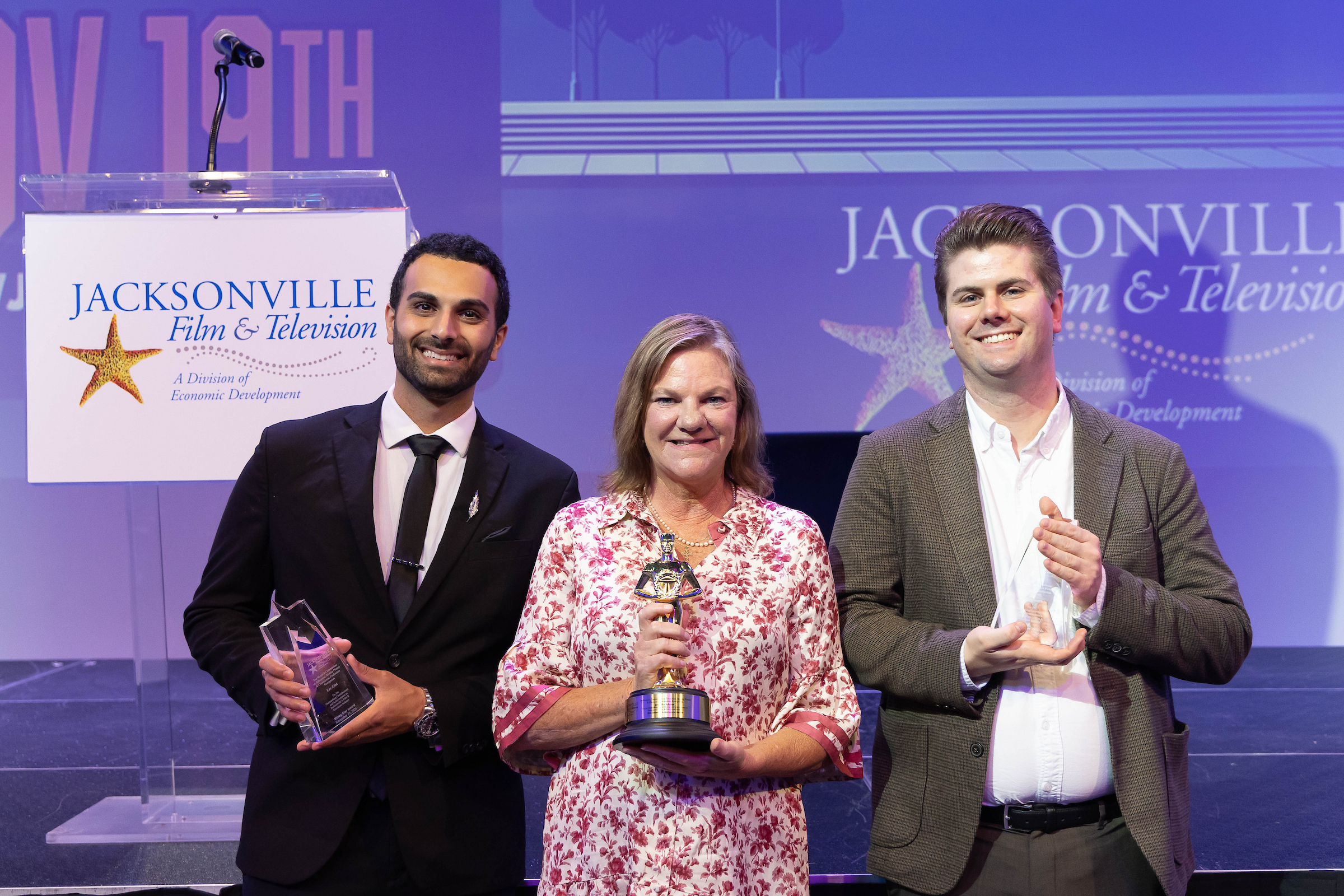
Jennifer Adams, co-founder of CROP Creative Media, received the 2026 Jacksonville Film & Television Industry Achievement Award for more than three decades of work in marketing, advertising, and media production. Adams spent 25 years building client relationships across Jacksonville production houses, serving as executive producer at White Hawk Pictures from 1991 to 2002 and at Digital Video Arts from 2002 to 2011. In 2012, she co-founded CROP Creative Media, which has grown from four employees to 10 full-time staff and regularly employs freelance production professionals.
At CROP, Adams serves as executive producer and strategic lead, managing client accounts, writing scripts, and developing campaign proposals. The company's client roster includes Florida Blue Foundation, Wounded Warrior Project, Jacksonville Zoo and Botanical Gardens, and Firehouse Subs Public Safety Foundation.
The 2026 Rising Star Award recipients were Lee Giat, founder of Flying Ostrich Media and a six-time Telly Award-winning filmmaker, and Tyler Smith, an award-winning producer and director who began working in the local industry as a production coordinator in 2018. The Rising Star Award recognizes professionals who have worked in film and television for fewer than 10 years and demonstrate significant early-career achievements.
Giat began his professional career in 2016, working on productions for CBS and ESPN before founding Flying Ostrich Media. His feature directorial debut, Wright of Passage, documented a 48-day solo flight across six countries and supported an educational initiative that provided STEM resources to more than 20,000 students across the Caribbean and South America.
Smith wrote and directed his first broadcast commercial in 2020 for 121 Financial Credit Union. His credits include work for FIS, Persistent Systems, Oracle, Goodwill of North Florida, Jacksonville ACPS, The Nonprofit Center of Northeast Florida, and Visit Jacksonville. In 2025, he won a District Silver ADDY for a brand film produced for First Coast YMCA. His latest narrative short film, Never to Return, won Best Short Film and Best Florida Film at the Sunscreen Film Festival.
What this means for Jacksonville's creative economy
The film and television production sector functions as both a direct employer and a force multiplier for related businesses in the regional economy. Production work generates demand for location rentals, catering, equipment suppliers, construction and fabrication services, hotels, transportation, and freelance creative professionals ranging from camera operators to sound engineers.
The $71. 1 million economic impact figure represents the cumulative spending tied to productions that received assistance from the city's Film & Television Office over 21 years—an average of approximately $3. 4 million per year. By comparison, a single large-budget feature film or television series can generate several million dollars in local spending during active production, while commercial shoots and corporate video projects typically involve smaller but more frequent transactions.
The growth of Jacksonville-based production companies such as CROP Creative Media signals the development of a sustainable local industry rather than reliance solely on visiting productions. Firms with full-time staff and established client relationships create year-round employment and anchor a network of freelance professionals who move between projects. CROP's expansion from four to 10 employees over more than a decade reflects the steady demand for video content driven by corporate communications, nonprofit storytelling, and digital marketing.
The company's client list—anchored by regional nonprofits, healthcare foundations, and community institutions—illustrates a production niche distinct from Hollywood feature work. Corporate and mission-driven video production tends to be less cyclical than entertainment filming and can support a stable crew base, though the work is typically lower-profile and involves smaller budgets than theatrical releases or streaming series.
How Jacksonville competes for production work
Florida does not currently offer the type of refundable tax credits that have made Georgia, Louisiana, and other southeastern states dominant hubs for feature film and television series production. Without those incentives, Jacksonville's film sector has concentrated on commercial work, corporate video, digital content, documentaries, and independent projects that do not depend on subsidy structures.
The Jacksonville Film & Television Office provides location scouting assistance, permitting coordination, and connections to local vendors—services that lower the friction costs of shooting in the region. The office's role is to streamline production logistics rather than to provide direct financial incentives, a model common among mid-sized markets that lack the budgets of state-level film commissions.
The region's assets for production work include a range of natural and built environments—beaches, rivers, urban cores, suburban neighborhoods, industrial zones—within a compact geography. WJCT Studios, where the awards reception was held, provides broadcast-quality facilities. The presence of corporate headquarters, healthcare systems, financial institutions, and national nonprofits generates ongoing demand for video production tied to marketing, training, investor relations, and public outreach.
Emerging talent development is a recurring challenge in mid-market production hubs. The Rising Star Award category—established to recognize professionals with fewer than 10 years of experience—reflects an industry priority to retain early-career workers who might otherwise migrate to larger markets. Giat and Smith both launched their careers locally and founded or built businesses in Jacksonville, a pattern that depends on sufficient project volume and professional networks to sustain a freelance or entrepreneurial career.
The broader Northeast Florida media landscape
The film and television production sector overlaps with Jacksonville's broader creative economy, which includes advertising agencies, graphic design firms, animation studios, gaming developers, and digital marketing companies. WJCT, the region's public media station, operates as both a broadcaster and a production facility, hosting events such as the awards reception and providing infrastructure for independent producers.
Jacksonville's status as a consolidated city-county government and Florida's most populous city provides a large institutional client base for video work—city departments, JEA, the school district, JAXPORT, and tourism agencies all commission content. Visit Jacksonville, the city's destination marketing organization, regularly contracts for promotional videos and social media campaigns, as noted in Smith's client list.
The military presence in Northeast Florida—Naval Station Mayport, Naval Air Station Jacksonville, and nearby Kings Bay submarine base—also generates production opportunities, particularly for defense contractors and veterans' nonprofits. The Wounded Warrior Project, one of CROP's clients and headquartered locally, is a significant commissioner of storytelling video content.
Education and workforce development remain open questions as the industry grows. Jacksonville does not have a major film school, though several regional colleges and universities offer media production programs. The career paths of the Rising Star winners—both of whom entered the industry through production assistant or coordinator roles rather than formal film school training—reflect an apprenticeship model common in markets without strong academic pipelines.
What happens next
The Jacksonville Film & Television Office continues to track production activity and provide support services to incoming projects and local businesses. The annual awards reception, now in its 25th year, is organized by the Mayor's Advisory Commission on Motion Picture, Television and Commercial Production, which advises city leadership on industry policy and promotion.
Mayor Donna Deegan, in remarks at the reception, expressed support for Jacksonville's continued growth as a production destination and highlighted the role of the film and television community in promoting the city's arts and culture. Todd Roobin, manager of the Jacksonville Film & Television Office, noted that the awards celebrate both individual accomplishment and the depth of local talent, emphasizing that experienced professionals, innovators, and emerging workers together shape the industry's future.
The office publishes production statistics and resources at filmjax. com. Future growth in the sector will depend on the sustained demand for digital content, the competitive positioning of Jacksonville relative to other regional markets, and the ability of local firms to retain and develop creative talent in an industry where workers are highly mobile.
As Northeast Florida continues to attract new residents and businesses, the production sector serves as both an economic asset and a tool for storytelling about the region. Corporate relocations, nonprofit expansions, and new real estate developments all require marketing and communications—a demand stream that supports the kind of steady, local production work that has allowed companies such as CROP to grow over decades rather than chase the boom-and-bust cycles of entertainment filming.
Sources
- City of Jacksonville: JACKSONVILLE’S FILM AND TELEVISION INDUSTRY CELEBRATES ACHIEVEMENTS