
Palm Coast creates Business Development Office, rehires Zobler
The Flagler County city is elevating business recruitment into a standalone office reporting directly to the city manager, part of a push to diversify its residential-heavy tax base.
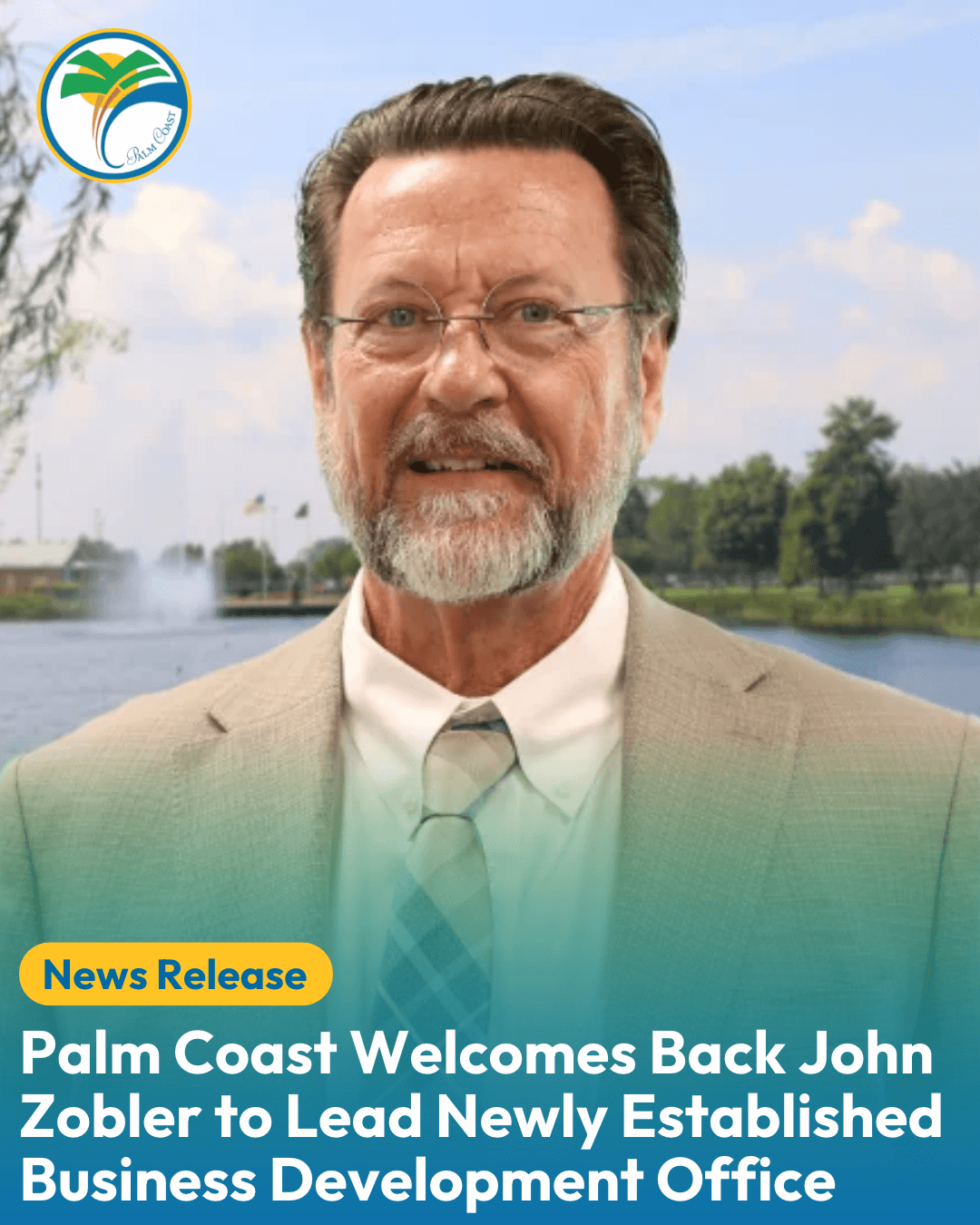
Palm Coast is reorganizing its economic-development function, elevating business recruitment from a departmental role to a standalone office reporting directly to the city manager and bringing back a former planning director to lead the effort.
The city announced November 9 that John Zobler, who previously served as Community Development Director, will return as Business Development Manager heading a newly branded Business Development Office within the City Manager's Office. The move is designed to give commercial recruitment higher visibility and more direct access to executive decision-making as the Flagler County city works to attract investment beyond the residential subdivisions that have driven decades of growth.
What's happening
The Business Development Manager position is being transferred from the Community Development Department to the City Manager's Office and rebranded as the Business Development Office, according to the announcement from City Manager Mike McGlothlin. Zobler, who brings institutional knowledge of Palm Coast's development landscape from his prior tenure, will fill the role.
The reorganization comes as the city pursues a more proactive strategy to recruit businesses and industries that can broaden the local economy. McGlothlin said the new structure is intended to provide "a more coordinated, hands-on approach to attracting businesses, building relationships with industry leaders, and turning economic development opportunities into results. "
The effort is tied to the city's recent acquisition of 23 parcels in Palm Coast's Town Center. The city intends to explore selling select properties to private-sector partners for commercial development, the announcement stated. No timeline or specific development targets were disclosed.
McGlothlin emphasized that the city's tax base currently relies heavily on residential properties and that attracting commercial investment is a priority for diversification. "Palm Coast has tremendous potential for business and industry, and we need to be intentional about how we pursue those opportunities," he said in the announcement.
Why tax base matters for Palm Coast
The organizational change reflects a challenge common to fast-growing bedroom communities across Florida: converting population growth into commercial investment that can shoulder more of the tax burden and reduce reliance on homeowners.
In Florida's property-tax system, cities and counties levy millage rates on the assessed value of real estate. Residential properties—especially homesteaded primary residences—enjoy significant tax advantages under state law, including the Save Our Homes cap that limits annual assessment increases to 3 percent and portability provisions that let homeowners transfer accumulated savings when they move. Commercial properties carry no such protections and are reassessed at full market value each year, making them more lucrative per acre for local governments.
A tax base dominated by residential rooftops means that as a city grows and demands for services increase—more road maintenance, more park acreage, more public-safety staff—the revenue to pay for those services grows more slowly than the costs, particularly when property values flatten or decline. Commercial development, by contrast, often generates more tax revenue per capita served and can reduce the per-household burden over time.
Palm Coast has grown rapidly since its incorporation in 1999, with much of that growth driven by age-restricted and family subdivisions spreading across former timberland west of Interstate 95. The city's population has more than tripled in two decades, but its commercial core has lagged. Town Center, the mixed-use district anchored by a Publix-anchored shopping plaza and City Hall, has long been envisioned as a walkable urban center but remains largely underbuilt, with vacant parcels scattered among low-rise retail and civic buildings.
By purchasing 23 parcels in Town Center—details of the acquisition were not provided in the announcement—the city has positioned itself to directly shape redevelopment. Selling land to private developers with conditions attached is a common economic-development tool in Florida, allowing municipalities to influence the type, design, and pace of projects while returning property to the tax rolls once built.
What the office will do
Under the new structure, the Business Development Office will work with city leadership and other departments to identify opportunities, build relationships with prospective businesses, and guide projects through the permitting and development process, according to the announcement.
In practice, this means the office is likely to function as both recruiter and concierge. Business-development managers in Florida cities typically attend trade shows and industry conferences, respond to site-selection consultants representing companies looking to expand, and work with brokers marketing available land and buildings. Internally, they often shepherd projects through zoning reviews, utility connections, environmental permitting, and other regulatory steps that can stretch timelines and frustrate developers unfamiliar with local requirements.
Placing the office within the City Manager's Office rather than a planning or community-development department signals that business recruitment is a strategic priority with executive backing. It also gives the office convening power: the ability to pull together department heads, expedite reviews, and escalate issues without navigating a multilayered bureaucracy.
Zobler's prior role as Community Development Director means he is already familiar with Palm Coast's land-development code, comprehensive plan, and the development-review process—knowledge that can help identify shovel-ready sites and anticipate permitting hurdles. His return suggests the city is prioritizing continuity and local expertise over an external search.
What this means for residents and businesses
For residents, the success or failure of the new office will ultimately show up in two places: the mix of retail and services available locally, and the annual property-tax bill.
More commercial investment can mean more shopping, dining, and entertainment options closer to home, reducing the need to drive to Daytona Beach or St. Augustine for goods and services. It can also mean more local jobs, though the type of business recruited matters: a logistics warehouse generates different employment and tax outcomes than a corporate office park or a medical campus.
If the city succeeds in attracting higher-value commercial development, the tax-base diversification McGlothlin described could, over time, reduce the relative burden on homeowners or create fiscal room for infrastructure improvements and service expansions without millage-rate increases. If commercial recruitment stalls, or if the city ends up subsidizing projects with incentives that erode net tax gains, the financial benefit will be limited.
For business owners and developers, the creation of a dedicated office with direct access to the city manager could streamline the often-fragmented process of bringing a project to fruition in a growing city. A single point of contact who can coordinate across departments and advocate internally is a common request from the development community, particularly for companies unfamiliar with a municipality's procedures.
The Town Center land bank also creates a concrete opportunity: developers interested in urban mixed-use projects now have a public partner with both land and motivation to deal. What remains to be seen is what conditions the city will attach—design standards, use restrictions, affordability requirements, or infrastructure contributions—and whether those terms will attract the caliber of development the city seeks.
What happens next
The announcement did not include a start date for Zobler or a detailed work plan for the Business Development Office. Residents and businesses interested in following the office's activities can monitor city manager updates, which are published weekly on the city's website at www. palmcoastgov. com/government/city-manager/week-in-review.
City Council meetings, typically held on the first and third Tuesdays of the month, are the public forum where economic-development incentives, land sales, and budget allocations would be debated and approved. Meeting agendas and video archives are available on the city's website.
Any disposition of the 23 Town Center parcels will require council approval and will likely involve public hearings, particularly if the city offers financial incentives or enters into development agreements with performance milestones. Details on the parcels—addresses, acreage, acquisition cost, and intended use—were not provided in the announcement but may appear in future council packets.
The reorganization fits into a broader pattern across Northeast Florida, where cities that boomed on residential growth are now working to catch up on the commercial side. In St. Johns County, Nocatee and SilverLeaf have added retail and office space alongside thousands of homes; in Clay County, economic-development officials have focused on attracting advanced manufacturing and logistics to balance bedroom-community growth. Palm Coast's approach—a dedicated office, direct executive oversight, and a land bank ready for deal-making—signals that Flagler County's largest city is making a similar bet on intentional, managed diversification as it enters its third decade.