
Palm Coast locks in fire department with voter-approval rule
New ordinance requires a supermajority City Council vote and citywide referendum before the Palm Coast Fire Department could be sold, transferred, or leased to another agency.
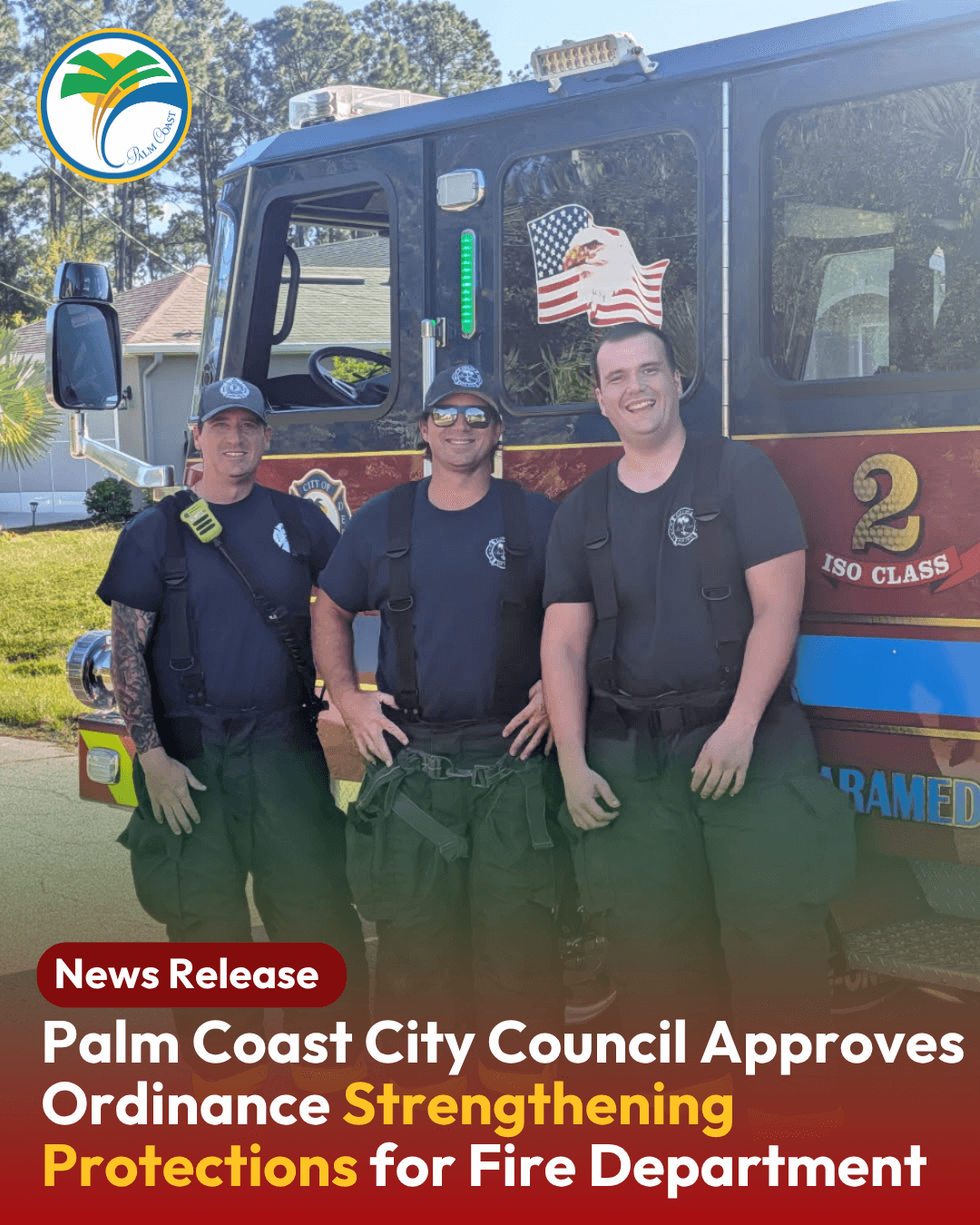
Palm Coast residents will now have direct say over the future of their fire department. The City Council on October 20 approved an ordinance that erects a high political barrier around the municipal fire service, requiring both a supermajority council vote and a majority of voters in a citywide referendum before the department could be sold, transferred, or placed under a long-term lease with another government agency or private company.
The ordinance took effect immediately after its second and final reading at the October 20, 2026 City Council business meeting. The council first discussed the measure at its September 8 workshop meeting and gave first reading approval on September 15.
What's happening
The ordinance mandates two levels of approval for any proposal to transfer control of the Palm Coast Fire Department. First, a supermajority of the City Council—more than a simple majority—would need to vote in favor. Second, the proposal would go to Palm Coast voters in a citywide referendum, where a majority would need to approve.
The new rule does not affect routine fire-department operations or collaboration with neighboring agencies. Mutual-aid agreements, shared emergency response, specialized training programs, and shared dispatch services may continue without a referendum. The city also retains authority to replace or dispose of outdated vehicles, equipment, and tools.
"I want to thank the City Council for continuing to make public safety and the well-being of our residents a top priority," City Manager Mike McGlothlin said in a statement. "The Palm Coast Fire Department is an essential part of our community, and this ordinance helps protect its future while ensuring residents have a say in any major decisions that could impact the department. "
Why Palm Coast locked in municipal control
The ordinance does not cite a pending transfer proposal or outside bid. Instead, it establishes a procedural firewall—one that reflects a broader national trend as growing Florida cities grapple with whether to expand in-house emergency services or contract them out.
In Florida, municipal fire services can be organized several ways: a city-operated department, a county-run system, an independent special district, or a private contractor. Each model has fiscal and service-delivery tradeoffs. By requiring a referendum, Palm Coast has effectively frozen its current model unless residents agree to change it.
The dual-approval mechanism—supermajority plus referendum—is unusual but not unique. Similar protections have appeared in other Florida cities that want to shield core services from future councils or outside pressure. The structure makes any transfer attempt a lengthy, public, and uncertain process, which typically discourages casual exploration of alternatives.
For residents, the practical effect is straightforward: no city manager, council majority, or outside agency can move the fire department out of city control without putting the question on the ballot. That guarantee is now embedded in local law.
What it means for property taxes and service levels
Fire service is one of the costliest line items in a municipal operating budget. Personnel, apparatus, stations, training, and benefits for a 24/7 service add up quickly, and the funding model directly affects property-tax rates and service response times.
Under the current city-operated model, Palm Coast funds its fire department through the general fund, which draws primarily on property taxes and utility fees. If the department were ever transferred to a county system or independent district, the funding stream would shift—potentially to a separate fire-service assessment or a county-wide millage. Voters would weigh that trade: whether a different structure could deliver the same or better service at lower cost, or whether consolidation would dilute local control and slow response in a growing city.
The ordinance does not lock in staffing levels, station locations, or budget allocations—those remain council decisions each budget cycle. What it does lock in is the governance model. Future debates over station expansions, apparatus purchases, or staffing ratios will happen within the city budget process, not as part of a transfer negotiation with an outside entity.
For homeowners and commercial property owners, the ordinance offers predictability. Insurance rates for structures are partly a function of fire-service ISO ratings, which measure response time, water supply, and department capabilities. A stable governance model reduces the risk of service disruptions or coverage gaps that could affect ISO scores and, in turn, insurance premiums.
How voter control shapes long-term planning
Palm Coast is in Flagler County, one of Florida's faster-growing small counties. The city's population has climbed steadily, and residential construction continues on the west side and along the Old Kings Road corridor. Growth drives demand for additional fire stations, personnel, and equipment—capital investments that play out over decades.
By anchoring fire-department governance to voter approval, the ordinance ensures that any major structural change will be debated in public, not negotiated behind closed doors. That transparency can be an asset during annexation discussions, interlocal-service agreements, or regional consolidation talks. Neighboring jurisdictions and developers now know that Palm Coast's fire service is not on the table unless residents put it there.
The flip side is rigidity. If a future council identifies cost savings or service improvements through a transfer or regional partnership, the supermajority-plus-referendum rule means the path forward is slower and politically riskier. Councils may be reluctant to spend political capital on a referendum campaign, even if the policy case is strong. In practice, the ordinance makes the status quo the default.
For regional emergency planning, the ordinance should not create friction. Mutual-aid agreements—where departments help each other across jurisdictional lines during large incidents—are a bedrock of fire service in Florida and are explicitly carved out of the ordinance. Palm Coast Fire can continue to respond into unincorporated Flagler County, and county units can respond into Palm Coast, without triggering the referendum requirement.
Similarly, shared dispatch and training arrangements, which are common cost-saving measures among neighboring departments, remain available. The ordinance targets governance and ownership, not operational cooperation.
What happens next
The ordinance is now in effect. No further council action is required, and no implementation period applies. The supermajority and referendum requirements are live.
There is no public indication that the city has been approached by another agency or contractor about a transfer, nor has the council directed staff to study alternatives. The ordinance functions as a preemptive lock, not a response to an active proposal.
Residents will not vote on the ordinance itself—it is a legislative act of the council under the city's charter authority. The voter referendum provision applies only if a future council seeks to transfer the fire department. At that point, the council would need to draft a transfer proposal, pass it by supermajority, place a referendum question on a city election ballot, and campaign for voter approval.
Future City Council candidates and interest groups now have a ready-made campaign issue: each candidate's position on fire-department governance is effectively a pledge on whether they would ever seek to undo the ordinance or pursue a transfer. Voter sentiment on the ordinance will be tested indirectly through council elections rather than directly unless a transfer is proposed.
Palm Coast's move reflects a broader pattern across Northeast Florida and the state, where fast growth is forcing cities to lock in or re-examine how they deliver core services. As the region adds tens of thousands of residents, the fiscal and operational architecture of fire, police, water, and roads comes under pressure. Communities that secure voter buy-in early often find it easier to plan capital investments and maintain service levels. Those that leave governance questions open can face years of uncertainty that stalls station construction, complicates bond financing, and rattles employee retention. By requiring voter approval, Palm Coast has chosen stability and public input over flexibility, a trade that will shape the city's public-safety landscape for years to come.