
Palm Coast City Council Seats Three New Members, Realigns Board Liaisons
Tony Amaral Jr., Ray Stevens, and Darlene Shelley took office Tuesday, completing a leadership transition that began with resignations and appointments over the past two years.
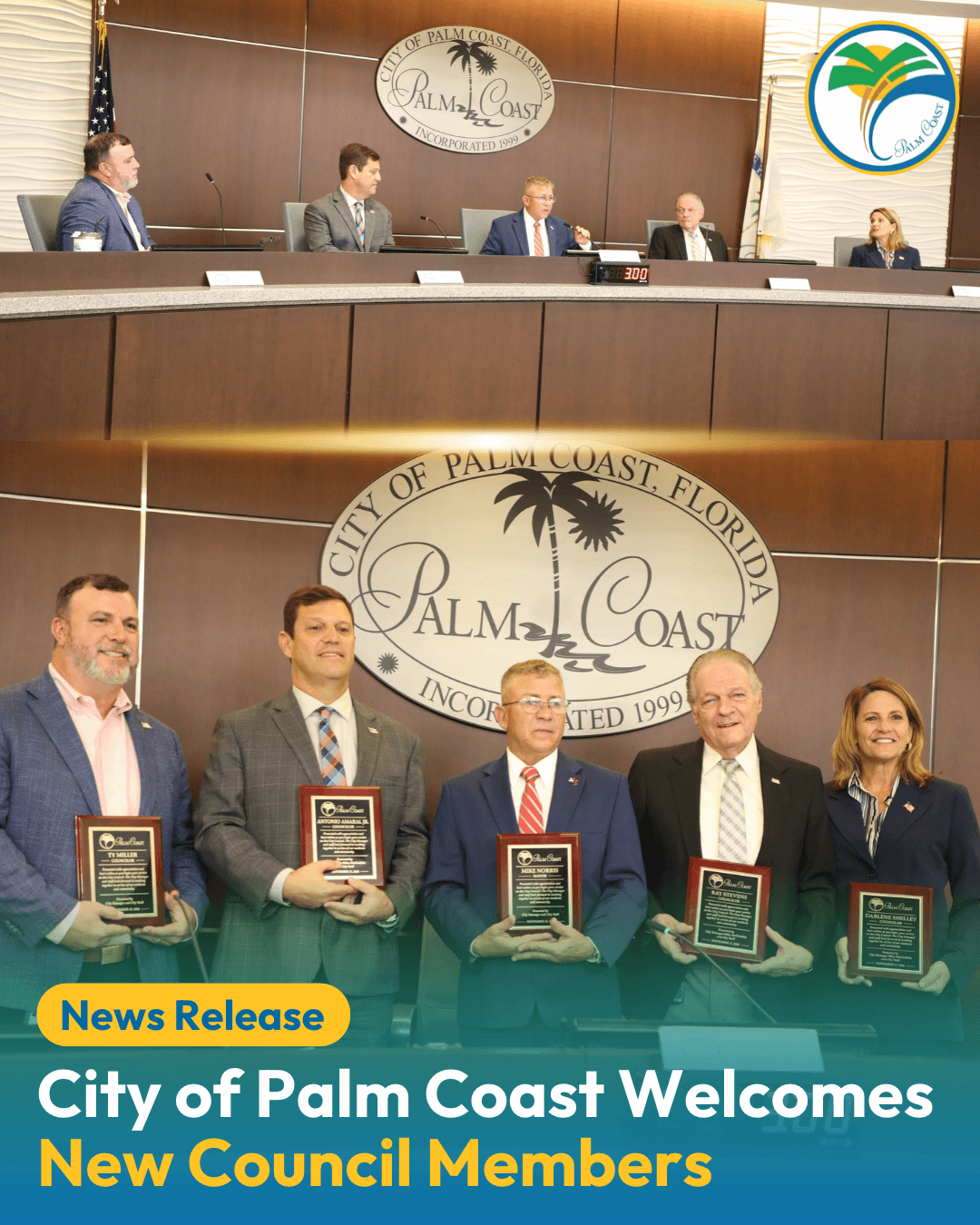
Three new members joined the Palm Coast City Council on Tuesday, November 17, completing a leadership transition that reshapes the board governing Flagler County's largest municipality. Tony Amaral Jr. representing District 2, Ray Stevens in District 3, and Darlene Shelley from District 4 were sworn into office during a business meeting at City Hall, replacing Vice Mayor Theresa Pontieri and Council Members David Sullivan and Charles Gambaro.
The swearing-in caps a two-year period of turnover on the five-member council. All three outgoing members served abbreviated terms after original electees resigned their seats, with Gambaro and Sullivan appointed in 2024 and 2025 respectively to fill vacancies, and Pontieri elected in November 2024 and serving through this month. With the new members seated, the council immediately selected Ty Miller to serve as vice mayor for the coming year. Miller and Mayor Mike Norris, both sworn in November 19, 2024, are now the longest-serving members of the body responsible for setting policy and approving development for the city of roughly 90,000 residents.
What's happening
The November 17 ceremony in City Council Chambers formalized the beginning of new terms for the three recently elected council members. City Manager Mike McGlothlin presented plaques to each of the new members as well as recognition plaques to Pontieri, Sullivan, and Gambaro for their service. Mayor Norris and Vice Mayor Miller also received plaques marking their years of service beginning in November 2024.
Following the swearing-in, Mayor Norris nominated Council Member Ty Miller to serve as vice mayor for the 2026–2027 fiscal year. The council approved the selection. Under Palm Coast's structure, the vice mayor is chosen annually by the council and assists the mayor with official duties and responsibilities as needed. Miller has served on the council since November 2024, making him the body's longest-serving member alongside Norris.
The council also finalized liaison assignments to eleven boards, committees, and regional organizations. These assignments connect council members to bodies ranging from the Affordable Housing Advisory Committee and Flagler Humane Society to the Volusia-Flagler Transportation Planning Organization and St. Johns River Water Management District. Council Member Shelley will serve as liaison to the Affordable Housing Advisory Committee and the Family Life Center. Council Member Amaral was assigned to the Flagler County Cultural Council. Council Member Stevens will liaison with the Flagler Humane Society and Florida Department of Juvenile Justice Circuit 7.
Vice Mayor Miller drew four assignments: the Flagler Schools Oversight Committee, the Joint Cities and County Workshop alongside Mayor Norris, the Volusia-Flagler Transportation Planning Organization, and the Tourist Development Council. Mayor Norris will represent the city on the Flagler County Transportation Disadvantaged Local Coordinating Board, the St. Johns River Water Management District, and the Northeast Florida Regional Council, in addition to serving as alternate on several other committees.
What council turnover means for development approvals
The composition of the City Council directly shapes how Palm Coast manages one of Florida's core growth pressures: residential development approvals, land-use changes, and infrastructure investment priorities. Council members vote on rezonings, annexations, development agreements, and capital budgets that determine where and how the city expands. With three new members taking office simultaneously, the voting dynamic on contentious land-use questions is resetting.
Palm Coast, like much of Flagler County, has seen sustained residential growth over the past decade as buyers priced out of coastal St. Johns County and metro Jacksonville look inland. The city's planning and land development code governs the pace and pattern of that growth—whether new subdivisions cluster near existing infrastructure or extend water, sewer, and road networks into undeveloped parcels. The council approves or denies comprehensive-plan amendments that change land-use designations, a prerequisite for rezoning agricultural or conservation land to residential or commercial use.
New council members typically face a learning curve on the technical aspects of land-use regulation: understanding traffic concurrency standards, stormwater management requirements, the role of the planning and land development board in vetting applications, and how development orders are conditioned. The transition period following an election can slow or reshape projects in the pipeline if applicants anticipate they will need to re-educate a new council on project merits or if voting coalitions shift on issues such as density limits, open-space requirements, or fiscal impact thresholds.
The city's development services staff and planning board will continue to review applications under existing code, but final authority on major rezonings and plan amendments rests with the five-member council. Developers, neighborhood groups, and infrastructure advocates will watch early votes to gauge where the new members stand on growth-management questions that have divided prior councils.
How regional board assignments shape city influence
The liaison assignments finalized by the council extend Palm Coast's voice into regional decision-making on transportation, water management, education funding, and economic development. Several of these bodies wield direct authority over infrastructure and regulatory outcomes that determine whether and how development proceeds in Flagler County.
The Volusia-Flagler Transportation Planning Organization, assigned to Vice Mayor Miller with Council Member Amaral as alternate, prioritizes federal and state transportation dollars and shapes the long-range plan for roads, transit, and bicycle-pedestrian facilities across the two-county region. Projects on major corridors such as State Road 100, U. S. 1, and Palm Coast Parkway depend on TPO funding allocations and air-quality conformity findings. A council member's presence on the TPO board allows Palm Coast to advocate for road-widening, intersection improvements, and trail connections that relieve traffic pressure from new residential subdivisions.
Mayor Norris will represent the city on the St. Johns River Water Management District governing board, with Council Member Shelley as alternate. The district issues consumptive-use permits for large-scale water withdrawals and environmental resource permits for projects that affect wetlands, floodplains, and stormwater discharge. Any major development in Palm Coast that involves wetland fill, modification of drainage systems, or new utility wells must obtain SJRWMD approval. Having a council representative on the district board provides insight into permit-review timelines and regulatory priorities, and positions the city to comment on regional water-supply planning that affects future growth capacity.
The Flagler Schools Oversight Committee assignment, held by Vice Mayor Miller with Council Member Amaral as alternate, links the council to public-school capacity planning. School concurrency—ensuring that classroom seats are available before new housing is occupied—remains a constraint on residential development approvals under Florida law. As new subdivisions add students, the city and county negotiate with the school district on impact fees, land dedications for new school sites, and the timing of capacity expansions. A council liaison can track enrollment projections and capital budgets, information that feeds back into land-use decisions when the council evaluates the fiscal and service impacts of annexing and rezoning large parcels.
Other assignments—Affordable Housing Advisory Committee, Tourist Development Council, Northeast Florida Regional Council—position council members in forums where economic development incentives, tourism marketing, and housing policy are debated and where the city can coordinate with St. Johns, Clay, and Nassau counties on shared infrastructure challenges.
How residents engage with the new council
Palm Coast residents can address the City Council during public-comment periods at regular business meetings, typically held on the first and third Tuesday of each month at City Hall. The city also schedules public hearings on rezoning applications, budget amendments, and comprehensive-plan changes, where residents may speak for or against specific proposals. Agendas and meeting materials are posted in advance on the city's website.
Council members serve four-year staggered terms representing geographic districts. The mayor is elected at-large. District 1, currently held by Mayor Norris, and District 5, an at-large council seat, were not up for election this cycle. The next regular election will determine whether the newly seated members earn full terms beyond any remainder they are completing.
Citizens with questions about how a proposed development affects their neighborhood, or who want to understand the city's capital improvement priorities for roads, stormwater, or parks, can contact their district council member or attend planning and land development board meetings, which provide early review of applications before they reach the council. The city's development services department publishes active applications and review status online.
For residents tracking growth issues, key votes to watch include comprehensive-plan amendments that increase residential density, annexation agreements that bring county land into the city's jurisdiction and service area, and budget allocations for utility expansions and road projects that unlock developable land. The new council will also participate in updating the city's strategic plan and capital improvements schedule, processes that set multiyear priorities.
What comes next for Palm Coast
The newly configured council will navigate a period of rapid regional growth. Flagler County consistently ranks among Florida's fastest-growing counties by percentage, driven by relative affordability and proximity to employment centers in St. Johns County and Jacksonville. Palm Coast accounts for the majority of the county's population and captures much of the residential development pressure.
In the coming months the council will consider the city's annual budget for fiscal year 2027, approve or deny pending rezoning and annexation applications, and set policy on infrastructure funding mechanisms such as impact fees and utility connection charges that determine how growth pays for itself. Council members will also engage in state legislative advocacy on issues including property insurance reform, transportation funding formulas, and preemption of local land-use authority, all of which affect the city's ability to manage its built environment.
The liaison assignments formalized this week position the new council to coordinate with regional partners on shared challenges: school capacity, roadway improvements funded through the TPO, water supply and wetlands permitting through SJRWMD, and affordable housing strategies. How the council balances pro-growth constituencies, infrastructure constraints, and neighborhood livability concerns will shape Palm Coast's physical development for years to come.
With three new voices at the dais, the city enters a period of recalibrated priorities and voting coalitions. Developers, residents, and regional planners alike will watch early decisions for signals on density tolerance, fiscal conservatism, and the council's willingness to extend urban services into undeveloped areas—questions at the heart of Northeast Florida's ongoing transformation from rural hinterland to suburban frontier.